Mouth Taping for Athletes: The Complete Guide
Share
Mouth taping for athletes is a simple overnight intervention that forces nasal breathing during sleep, and the payoff shows up where it matters most: deeper, less fragmented sleep, higher heart rate variability, and faster recovery between hard sessions. If sleep is the single biggest lever you control for adaptation, mouth breathing is the leak that quietly drains it every night. Taping the mouth closed plugs that leak. This is the hub for everything we've published on how nasal breathing, sleep, and recovery fit together for people who train hard.
Most athletes obsess over training load, macros, and the latest supplement while treating the eight hours where their body actually rebuilds as an afterthought. That's backwards. Below is the full picture: why sleep drives recovery, how mouth breathing degrades it, the performance case for nasal breathing day and night, what your wearable will show, and how to build mouth tape and nasal strips into a protocol that fits your sport.
Why Sleep Is the #1 Recovery Lever
You don't get stronger in the gym. You get stronger in the hours after, when your nervous system down-shifts, growth hormone pulses, and damaged tissue rebuilds. Nearly all of that work happens during sleep, and most of it during slow-wave (deep) sleep.
Deep sleep is when the physical repair happens. The largest natural pulse of growth hormone occurs during the first few cycles of slow-wave sleep. Growth hormone drives muscle protein synthesis, tissue repair, and fat metabolism. Cut deep sleep short and you cut that pulse short, blunting the exact process you trained to trigger.
Sleep is where your nervous system resets. Hard training spikes sympathetic ("fight or flight") activity. Overnight, a well-rested athlete shifts into parasympathetic dominance, the "rest and digest" state that clears metabolic waste, restores hormonal balance, and prepares you to absorb the next session. Poor sleep leaves you stuck in a low-grade stress state, and that shows up as stalled progress and nagging fatigue.
The research is blunt about the cost of getting this wrong. Studies on sleep-restricted athletes show reduced time to exhaustion, slower sprints, higher perceived effort, and elevated injury risk. We've collected the practical side of this in our guide to science-backed tips to boost your recovery, and the specific hormonal angle in how sleep affects testosterone. The takeaway is the same: no recovery modality matters more than the sleep you're actually getting.
How Mouth Breathing During Sleep Degrades Recovery
Here's the problem. You can be in bed for nine hours and still get poor-quality recovery if you're breathing through your mouth all night. When your jaw drops open during sleep, three things go wrong at once.
Your sleep fragments. Mouth breathing is strongly associated with snoring and airway instability. As the tongue falls back and the airway narrows, airflow turns turbulent, tissue vibrates, and your brain triggers micro-arousals to reopen the airway. You may never remember waking, but each arousal pulls you out of deep sleep. The result is a night that looks long on paper but is shallow and broken in reality.
Your sympathetic tone stays elevated. Fragmented, mouth-breathing sleep keeps the stress side of your nervous system switched on. Instead of dropping into parasympathetic recovery, you spend the night in a semi-activated state. Your resting heart rate stays higher, your HRV stays suppressed, and you wake up feeling unrested even after a full night in bed.
You lose deep sleep and the growth hormone that comes with it. Because the deepest stages are the first to get sacrificed when the airway is unstable, chronic mouth breathers often run short on exactly the slow-wave sleep that drives physical repair. Less deep sleep means a smaller growth hormone pulse and slower recovery, night after night.
Then there are the everyday tells: dry mouth, a parched throat, and grogginess in the morning are all signatures of a night spent breathing through your mouth. For an athlete, this isn't a cosmetic annoyance. It's evidence that the recovery window you counted on didn't deliver.
The Nasal Breathing Performance Connection
Nasal breathing isn't just "not mouth breathing." The nose does active physiological work that the mouth simply can't replicate, and that work is directly relevant to performance and recovery.
Nitric oxide. Your sinuses continuously produce nitric oxide, a molecule that widens blood vessels and improves the efficiency of oxygen transfer from lungs to blood. You only harvest it when you breathe in through your nose, drawing that nitric oxide down into the lungs. Mouth breathing bypasses it entirely. Better oxygen delivery means better endurance, better power output, and better recovery. We break the mechanism down further in how nasal breathing improves heart rate variability.
Oxygen efficiency and CO2 tolerance. Nasal breathing is slower and more resistant than mouth breathing, which naturally raises the level of carbon dioxide your body tolerates. That matters more than it sounds: CO2 is what actually triggers oxygen to release from hemoglobin into working muscle (the Bohr effect). Athletes who breathe through the nose develop higher CO2 tolerance, which translates to more efficient oxygen use, a calmer breathing response under load, and less of the panicked over-breathing that wastes energy in the back half of a race.
Air conditioning and filtration. The nose warms, humidifies, and filters incoming air before it reaches your lungs. Cold, dry, unfiltered mouth air is harsher on the airways and can worsen exercise-induced airway irritation. Nasal air arrives at the lungs primed for efficient gas exchange.
For the deeper dive, our companion piece on the role of nasal breathing in athletic performance and recovery covers the full physiology.
Daytime Nasal Breathing During Training
Overnight taping is where most athletes start, but the same physiology applies during training. Breathing exclusively through your nose while you train forces a slower, more controlled breathing pattern and steadily builds CO2 tolerance and oxygen efficiency.
The MAF method. Popularized in endurance circles, the low-heart-rate MAF (Maximum Aerobic Function) approach pairs naturally with nasal breathing. Because you can only sustain nasal breathing up to a certain intensity, your nose becomes a built-in governor that keeps you in the aerobic zone where the biggest endurance base is built. If you're gasping and have to open your mouth, you've gone too hard, which is exactly the feedback aerobic-base training is supposed to give you.
Start conservative. Nasal-only training feels harder at first because your CO2 tolerance hasn't adapted yet. Begin with easy zone-2 sessions, warm-ups, and cool-downs, then gradually extend the intensity you can hold while staying nose-only. Over weeks, paces that once forced your mouth open become comfortable through the nose. Runners will find the specifics in nasal breathing for runners and the broader question of whether you should breathe through your nose during exercise.
A quick honest note: at maximal intensities, everyone eventually needs the higher airflow the mouth provides, and that's fine. The goal isn't to never open your mouth. It's to make nasal breathing your default.
How Mouth Tape and Nasal Strips Fit an Athlete's Protocol
The two tools solve different problems, which is why serious users often run them together. Mouth tape addresses the demand side by keeping your mouth closed so air routes through the nose. Nasal strips address the supply side by mechanically widening the nostrils so nasal airflow is easy and effortless.
Mouth tape holds your lips gently closed overnight so your jaw can't fall open and default to mouth breathing when you're deep in sleep. Nasal strips lift and open the nasal passages from the outside, which is especially useful if you have mild congestion, narrow nostrils, or an airway that feels tighter lying down. Used together, you open the nose and close the mouth, guaranteeing the full night is nasal.
The order matters: open the nose first with the strip, confirm airflow feels easy, then apply the tape. That sequence is exactly what we lay out in using mouth tape and nasal strips together. For athletes who want the complete overnight system in one place, the Deep Sleep Bundle pairs both.
This isn't a fringe idea anymore. Coverage of elite athletes using mouth tape and the reasons athletes swear by mouth taping shows how far the practice has spread through pro locker rooms and endurance communities. Our own overview of mouth tape for athletes ties the recovery case together.
What the Wearable Data Shows
The best part of this intervention is that you don't have to take it on faith. If you wear an Oura ring, a WHOOP, or any device that tracks HRV and sleep stages, mouth taping is one of the few habits where the before-and-after is visible in the data within a week or two.
Deep sleep and sleep efficiency. Many people see measurable increases in deep sleep minutes and fewer nighttime awakenings once they stop mouth breathing. We documented the typical trajectory in what happens to your Oura score when you start mouth taping.
Resting heart rate and HRV. As sympathetic tone drops overnight, resting heart rate tends to fall and HRV tends to rise, both classic markers of improved recovery and readiness. This is the metric endurance and strength athletes should watch most closely, and it's covered in depth in HRV and sleep.
Respiratory rate and stability. Smoother, more stable overnight breathing shows up as a lower, steadier respiratory rate, another sign your airway held open through the night.
Run a clean test: capture two weeks of baseline data, then tape for two weeks and compare. The signal is usually obvious. For broader context, our biohacker sleep stack shows where mouth tape sits alongside the rest of your inputs.
Mouth Taping by Sport Type
Endurance athletes (runners, cyclists, triathletes, swimmers). You gain the most from the full nasal-breathing package. Overnight taping restores the deep sleep and HRV that let you absorb high mileage, while daytime nasal training builds the CO2 tolerance and aerobic efficiency that pay off on long efforts. This is the group where nose-only base training and taped sleep compound most powerfully.
Strength and power athletes (lifters, sprinters, throwers). Your priority is the growth hormone pulse and nervous-system reset that happen in deep sleep. Recovery between heavy sessions is the bottleneck on progress, and protecting slow-wave sleep with overnight taping directly supports the repair and hormonal output that strength adaptation depends on.
Combat athletes (MMA, boxing, wrestling, BJJ). You need it all: aerobic capacity, explosive power, and fast recovery across grueling training camps, often while cutting weight. Weight cuts and heavy volume wreck sleep quality precisely when you can least afford it. Nasal breathing also trains the composure to stay calm and controlled under oxygen debt, a real advantage when a scramble drags into the later rounds.
Team-sport athletes (soccer, basketball, football, hockey). Your season is a long grind of games, travel, and disrupted sleep. Consistent, high-quality recovery is what keeps you sharp in the final quarter and durable across a full schedule. Better deep sleep and HRV translate into faster reaction time, better decision-making, and lower injury risk over a demanding season.
The Titan Sleep System as a Recovery Tool
Put the pieces together and mouth taping stops looking like a gimmick and starts looking like what it is: a low-cost, high-leverage recovery tool. You already train hard, eat well, and track your metrics. The Titan Sleep System of mouth tape and nasal strips protects the one window where all of that work actually turns into adaptation.
It costs pennies per night, takes thirty seconds to apply, and produces changes you can verify on your own wearable. For an athlete looking for a genuine edge that isn't a supplement and isn't more training volume, better sleep through nasal breathing is one of the highest-return habits available. The Deep Sleep Bundle is the simplest way to run the full overnight system from night one.
Frequently Asked Questions
Does mouth taping actually improve athletic performance?
Mouth taping doesn't directly make you faster or stronger. It works indirectly, and powerfully, by improving the quality of your recovery. By forcing nasal breathing overnight, it protects deep sleep, raises HRV, and lowers resting heart rate, which are the conditions under which your body actually adapts to training. Better recovery means you show up to each session more ready to perform and less likely to break down. Most athletes see the effect in their wearable data within one to two weeks.
Should I mouth tape during training or just for sleep?
Start with sleep, since that's where the recovery payoff is largest and easiest to sustain. Mouth taping is an overnight practice. During training you don't tape; instead you practice keeping your mouth closed and breathing through your nose voluntarily, especially during easy and moderate efforts. Both habits build the same nasal-breathing physiology, but taping is only for sleep. At maximal intensity, opening your mouth for extra airflow is normal and expected.
Can nasal breathing really keep up with the oxygen demands of exercise?
Up to moderate and even fairly hard aerobic intensities, yes, especially once your CO2 tolerance adapts over several weeks. Nasal breathing improves oxygen efficiency, so you often need less total airflow than you assume. At truly maximal efforts, everyone needs the higher airflow the mouth allows, and that's completely fine. The goal is to make nasal breathing your default across the large majority of training, not to force it at all-out intensities.
What if I have a deviated septum or chronic congestion?
Nasal strips can help by mechanically opening the nasal passages from the outside, and many people with mild restriction find nasal breathing becomes comfortable once they add one. If you have a significant deviated septum, chronic congestion, or you can't breathe through your nose at all, address that first with a physician or ENT before taping, and don't tape if your nose isn't reliably clear. Forcing nasal breathing through a genuinely blocked nose isn't the goal.
How fast will I see results in my recovery metrics?
Most athletes notice reduced dry mouth and fresher mornings within a few nights. Wearable changes in deep sleep, HRV, and resting heart rate typically emerge within one to two weeks. The cleanest way to confirm it is to capture two weeks of baseline data before you start, then compare against two weeks of taped nights. The daytime benefits of nasal training, like improved CO2 tolerance and aerobic efficiency, build more gradually over several weeks of consistent practice.
The Bottom Line
Mouth taping for athletes works because it fixes the recovery window most training programs ignore. Sleep is where adaptation happens, mouth breathing quietly wrecks it, and taping the mouth closed restores the deep sleep, HRV, and hormonal repair that hard training depends on. Add nasal strips to keep the airway open, extend nasal breathing into your easy training days, and you've built a complete breathing protocol that supports performance from both ends.
It's cheap, it's simple, and unlike most recovery claims, you can prove it to yourself with the wearable already on your wrist or finger. Start with the sleep. Open the nose, close the mouth, and let the eight hours you were already spending in bed finally do their job.
Doctor Recommended: "As a maxillofacial surgeon and dentist, I recommend Titan Mouth Tape. Nasal breathing during sleep is essential for airway health and deep restorative rest. Titan's bamboo silk design is the most comfortable and effective mouth tape I have tested. If you struggle with snoring, dry mouth, or poor sleep quality, this is the simplest change you can make for your health." — Dr. Francois P., MD, DDS — Maxillofacial Surgeon
Lab-Tested Safety: Titan's adhesive is independently tested to ISO 10993 medical device standards. Non-toxic (95% cell viability). Non-allergenic (0% reaction rate). Non-irritating (score 0.0/8.0). PFAS-free — 501 compounds tested, zero detected. See full test results →
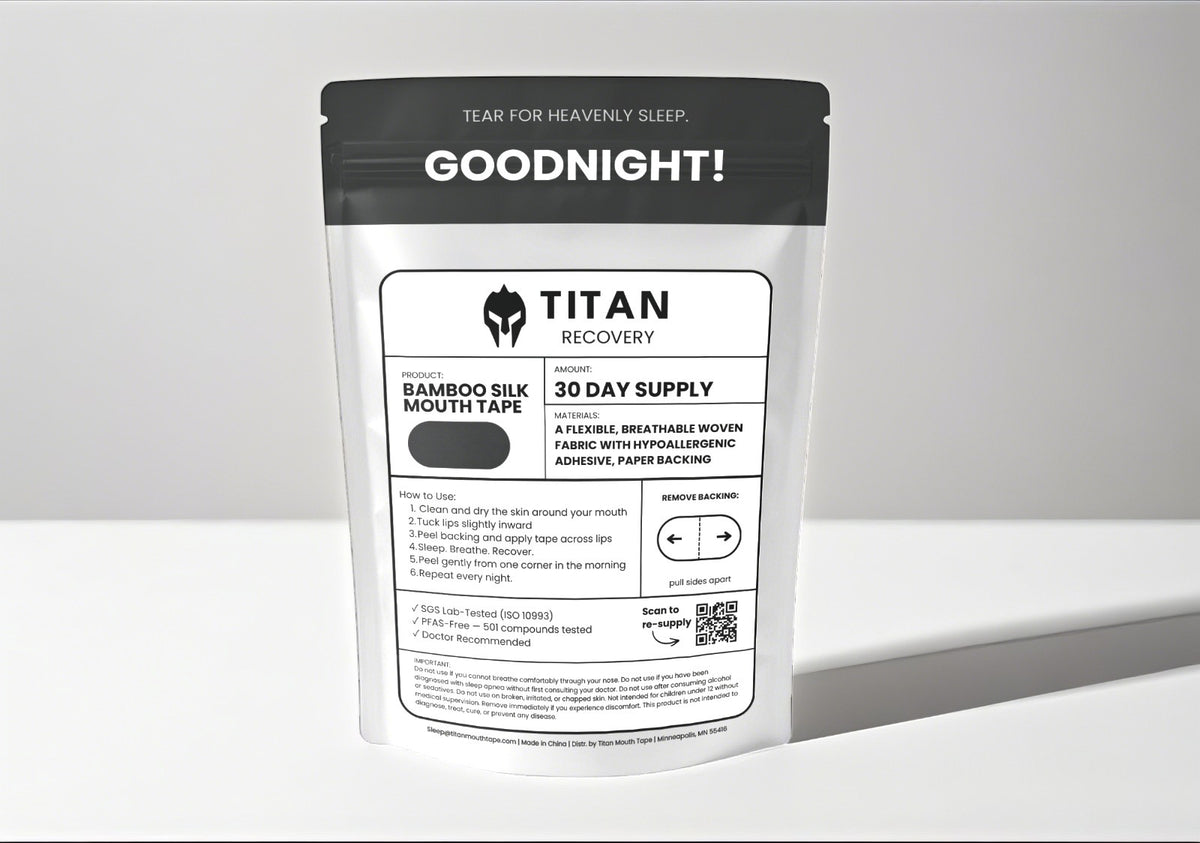
Try the complete system tonight. Titan Mouth Tape (bamboo silk, SilkSeal™ adhesive) + TitanAir Nasal Strips. Free shipping. 30-night Better Sleep Guarantee. Shop Titan Mouth Tape → · Shop TitanAir Nasal Strips →
Related reading
- Best Nasal Strips for Athletes
- Best Mouth Tape for Men
- What Mouth Tape Does Joe Rogan Use?
- Biohackers and Athletes Are Sleeping with Titan Mouth Tape™
- Top 10 Reasons Athletes Swear By Mouth Taping
- What Mouth Tape Do Joe Rogan, James Nestor, and Other Public Figure...
Want the tape built for this? Try Titan mouth tape from Titan — bamboo silk, beard-friendly, PFAS-free, with a 30-Night Better Sleep Guarantee.