Caffeine Before Bed: Why Timing Matters
Share
Caffeine has a half-life of five to six hours. That means the cup of coffee you drank at 3 p.m. is still 50% active in your system at 9 p.m. By midnight, roughly 25% of it is still circulating. Even if you fall asleep on time, feel fine, and hit your usual number of hours, caffeine before bed reduces deep sleep by up to 20%. You're asleep, but you're not recovering. And most people never connect the two because they don't feel wired when they close their eyes.
This isn't about quitting caffeine. Coffee is great. This is about timing it so it works for you instead of quietly working against you every night.
How Caffeine Actually Works in Your Brain
Throughout the day, your brain accumulates a molecule called adenosine. Adenosine is a byproduct of neural activity, and its job is straightforward: the more it builds up, the sleepier you feel. By evening, adenosine levels are high enough that your brain gets the signal to wind down and prepare for sleep.
Caffeine doesn't give you energy. It blocks the receptors that detect adenosine. The adenosine is still accumulating — your brain just can't sense it. You feel alert not because caffeine is adding something, but because it's hiding the tiredness signal. When the caffeine eventually wears off, all that built-up adenosine hits at once. That's the crash.
The problem for sleep is that caffeine doesn't clear your system on a switch. It decays gradually, following that five-to-six-hour half-life. So when you go to bed with caffeine still blocking a portion of your adenosine receptors, your brain's ability to regulate sleep depth is compromised. It can still initiate sleep — you can still fall asleep — but the architecture of that sleep gets disrupted from the inside.
The Half-Life Problem: A Timeline
The caffeine half life sleep connection becomes obvious once you map it out. A standard cup of coffee contains roughly 100mg of caffeine. Here's what happens depending on when you drink it, assuming a 10 p.m. bedtime:
2 p.m. coffee (8 hours before bed): By 10 p.m., roughly 25mg remains in your system. That's a manageable amount for most people — comparable to a few sips of green tea. Sleep impact is minimal.
4 p.m. coffee (6 hours before bed): By 10 p.m., roughly 50mg remains — half the original dose. That's enough to measurably reduce deep sleep even if you don't notice any trouble falling asleep. Your sleep tracker might look normal. You'll feel it in the morning.
6 p.m. coffee (4 hours before bed): By 10 p.m., roughly 70mg remains. At this level, research shows significant reductions in slow-wave deep sleep, delayed REM onset, and increased nighttime awakenings. This is the equivalent of drinking half a cup of coffee right before closing your eyes.
The math doesn't lie, and it doesn't care whether you "feel fine." Many people can fall asleep with caffeine in their system — their adenosine levels are high enough to overpower the remaining blockade. But falling asleep and sleeping well are different things.
How Caffeine Damages Sleep Quality
The question isn't whether you can fall asleep after caffeine before bed. The question is what happens to the sleep you get.
Deep sleep takes the biggest hit. Slow-wave sleep — the stage where physical repair, immune function, and memory consolidation happen — is the most sensitive to caffeine interference. Studies show that caffeine consumed six hours before bed can reduce deep sleep by 20% or more. That's the difference between waking up recovered and waking up tired after a full night.
REM sleep gets delayed. Caffeine pushes REM cycles later into the night, which means your most important REM periods — the ones in the final hours of sleep — get compressed or cut short when your alarm goes off. REM is where emotional processing and creative problem-solving happen. Less of it means more brain fog, more irritability, and worse decision-making the next day.
Micro-arousals increase. Even when you don't fully wake up, caffeine increases the number of brief transitions toward lighter sleep stages throughout the night. These micro-arousals are invisible to you — you won't remember them — but they fragment your sleep architecture. Your tracker might show seven or eight hours. Your body experienced something closer to a series of disconnected naps. Does caffeine affect deep sleep even if you sleep through the night? Absolutely. That's the part most people miss.
Hidden Caffeine Sources You Might Not Count
Most people track their coffee intake but forget about everything else. Caffeine hides in places you wouldn't expect:
Dark chocolate. A single serving of dark chocolate (about 1 oz of 70-85% cacao) contains 20-25mg of caffeine. An after-dinner chocolate habit adds up, especially if you're eating several squares.
Tea. Black tea delivers 40-70mg per cup. Green tea runs 25-50mg. Even herbal teas that contain yerba mate or guayusa carry significant caffeine loads. "Switching to tea in the afternoon" only helps if it's truly caffeine-free.
Pre-workout supplements. A standard pre-workout scoop contains 150-300mg of caffeine — as much as two or three cups of coffee. An afternoon gym session with pre-workout can put more caffeine in your system at bedtime than the morning coffee you're being so careful about.
Some medications. Certain pain relievers, migraine medications, and cold remedies contain caffeine as an active ingredient. A single dose of Excedrin contains 65mg. Check the labels on anything you take in the second half of the day.
Decaf coffee. It's not zero caffeine. A cup of decaf typically contains 5-15mg. One cup is irrelevant. Three or four cups of decaf in the evening start to add up to a meaningful amount.
The Cutoff Rule
How long before bed to stop caffeine? The research points to 8-10 hours as the safe window for most people. If you go to bed at 10 p.m., that means your last caffeine should be between noon and 2 p.m.
That might sound aggressive. It's based on the pharmacology. Two half-lives is the point at which most people retain only about 25% of the original dose — enough for your adenosine system to function normally during sleep.
Some people need an even longer window. Genetics play a real role here: roughly half the population carries a variant of the CYP1A2 gene that makes them slow caffeine metabolizers. For these people, the half-life extends to eight hours or more, and a noon coffee can still meaningfully affect sleep at midnight. If you've always been "sensitive to caffeine" or if you follow the 8-hour rule and still notice poor sleep, you may be a slow metabolizer. Push your cutoff to 10-12 hours before bed and see what changes.
The practical move: run a two-week experiment. Set a hard cutoff — noon is a clean starting point — and track how you feel in the morning. Most people notice a difference within the first week.
What to Drink Instead After the Cutoff
The afternoon slump is real, and if you're used to solving it with caffeine, you need replacements that don't feel like punishment.
Sparkling water with citrus. The carbonation and flavor provide a sensory break without any stimulants. It sounds underwhelming until you try it — the ritual of making a drink matters as much as what's in it.
Rooibos tea. Naturally caffeine-free, slightly sweet, and substantial enough to feel like an actual beverage. It won't mimic the taste of coffee, but it fills the same psychological role of a warm afternoon drink.
Electrolyte mixes. Afternoon fatigue is often partially driven by dehydration. A glass of water with electrolytes addresses the root cause without adding caffeine to the equation.
Decaf (with limits). If you truly need the coffee taste, one cup of decaf in the early afternoon is fine. Just don't stack multiple cups into the evening — that 5-15mg per cup accumulates.
The Double Hit: Caffeine Plus Mouth Breathing
Here's where things compound. Caffeine and sleep quality is one piece. Breathing during sleep is another. When both are working against you, the damage multiplies.
Caffeine reduces deep sleep from the chemical side — blocking adenosine receptors and preventing your brain from fully committing to slow-wave sleep. Mouth breathing reduces deep sleep from the mechanical side — activating the sympathetic nervous system, dropping blood oxygen, and triggering micro-arousals. When both are present in the same night, you get a compounding effect. Not additive — worse than additive. Each problem makes the other harder for your body to compensate for.
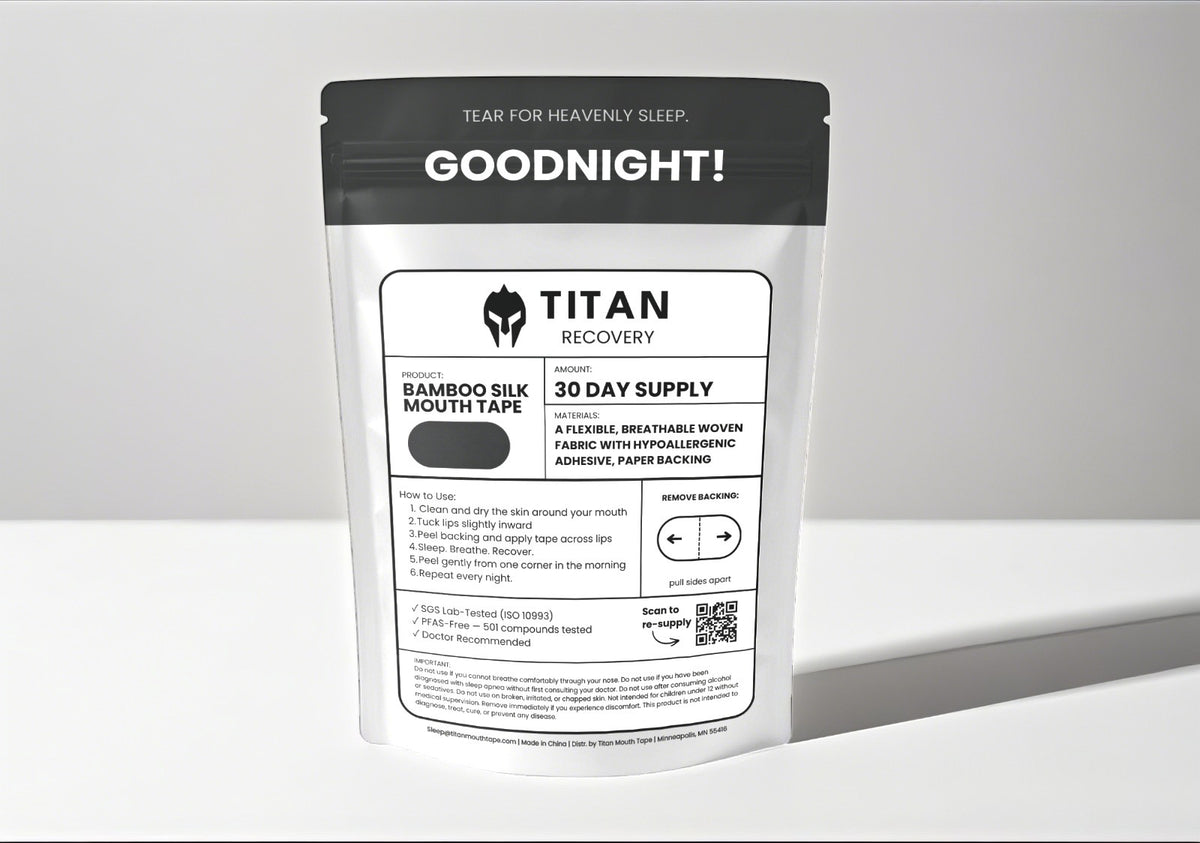
This is why fixing caffeine timing alone doesn't always solve the problem. You clean up your afternoon intake, and your sleep improves — but maybe not as much as you expected. That gap is often mouth breathing picking up where caffeine left off. Deep sleep depends on nasal breathing to keep the parasympathetic nervous system engaged throughout the night. Titan Mouth Tape holds the lips closed so your airway stays optimized while you sleep, and TitanAir Nasal Strips open the nasal passage for anyone who feels congested or restricted.
Fix caffeine timing to remove the chemical interference. Fix your breathing to remove the mechanical interference. Stack both and you give your body a real chance at the deep, unbroken sleep it needs.
Frequently Asked Questions
Can I drink caffeine before bed if I fall asleep fine?
Falling asleep is not the same as sleeping well. Caffeine reduces deep sleep and increases micro-arousals even when it doesn't prevent sleep onset. The damage is invisible — you won't feel it happening during the night. You'll feel it the next morning as fatigue, brain fog, and a vague sense of being unrested despite adequate hours. The fact that you can fall asleep with caffeine in your system doesn't mean your sleep is unaffected.
How long before bed should I stop drinking caffeine?
Eight to ten hours before bed is the standard recommendation based on caffeine's half-life. For a 10 p.m. bedtime, that means cutting off between noon and 2 p.m. If you're a slow caffeine metabolizer (genetically, about half the population), you may need 10-12 hours. The simplest test is a two-week experiment: set a hard noon cutoff and see whether your mornings feel different.
Does decaf coffee affect sleep?
A single cup of decaf contains 5-15mg of caffeine, which is negligible for most people. But multiple cups stack up. Four cups of decaf in the evening could deliver 40-60mg of caffeine — nearly as much as a half cup of regular coffee. One cup of decaf after your cutoff is fine. Just don't treat it as unlimited because it has "decaf" on the label.
What if I cut caffeine early and I'm still tired in the morning?
Caffeine is one variable. Breathing is another. Poor sleep quality has multiple causes, and mouth breathing during sleep independently fragments deep sleep and REM cycles. If caffeine timing is dialed in and you're still waking up drained, mouth breathing is worth investigating. A dry mouth in the morning, snoring, or a sore throat are all signs that your airway needs attention. People who've tried supplements without results often find that the mechanical problem was there the whole time.
The Bottom Line
Caffeine is not the enemy. Timing is everything. A cup of coffee at 7 a.m. and another at noon will serve you well. That same coffee at 4 p.m. will quietly erode the sleep you get seven hours later — not by keeping you awake, but by stealing the deep, restorative stages your brain and body depend on. Set a cutoff, watch for hidden sources, and give your system a clean runway into the night. And if cleaning up caffeine timing still leaves you short, look at how you're breathing. Mouth tape and nasal strips close the other half of the equation — the half that caffeine can't fix.
Doctor Recommended: "As a maxillofacial surgeon and dentist, I recommend Titan Mouth Tape. Nasal breathing during sleep is essential for airway health and deep restorative rest. Titan's bamboo silk design is the most comfortable and effective mouth tape I have tested. If you struggle with snoring, dry mouth, or poor sleep quality, this is the simplest change you can make for your health." — Dr. Francois P., MD, DDS — Maxillofacial Surgeon
Lab-Tested Safety: Titan's adhesive is independently tested to ISO 10993 medical device standards. Non-toxic (95% cell viability). Non-allergenic (0% reaction rate). Non-irritating (score 0.0/8.0). PFAS-free — 501 compounds tested, zero detected. See full test results →
Try the complete system tonight. Titan Mouth Tape (bamboo silk, SilkSeal™ adhesive) + TitanAir Nasal Strips. Free shipping. 30-night Better Sleep Guarantee. Shop Titan Mouth Tape → · Shop TitanAir Nasal Strips →