What to Expect Your First Week of Mouth Taping
Share
Most people adjust to mouth taping within 3 to 7 nights. The first night can feel odd -- you notice the tape and breathe through your nose more deliberately -- but the sensation fades fast. Early benefits like less dry mouth and a calmer throat often show up within the first few mornings, well before the habit fully settles in.
Knowing how the week actually unfolds -- night by night, what's normal and what isn't -- is the single best way to get past the awkward start instead of quitting on night two.
What should you do before you start?
Clear your nose first. Nasal congestion is the biggest reason a first week goes badly. If you can't breathe comfortably through your nose while lying down, mouth tape has nothing to work with. A saline rinse before bed helps, and TitanAir Nasal Strips physically open your nostrils if you tend to stuff up at night. Many beginners run mouth tape and nasal strips together for the first week -- the pairing sold as the Deep Sleep Bundle -- for the easiest possible airflow.
Start with clean, dry lips. Oil, balm, and moisturizer are the top reasons tape won't stick. Wash your face, dry the skin around your mouth, and skip the lip balm right before bed.
Consider a practice run. You don't have to jump straight to a full night. Wearing tape for 20 to 30 minutes while reading or watching TV shows your nervous system that you can breathe fine, so night one feels less like an experiment. Some people also start with a smaller piece of tape or a center strip rather than sealing the lips fully. Our step-by-step starter guide walks through both approaches.
What does the first night feel like?
The first few minutes are the strangest part. You lie down and your brain fixates on your mouth. You feel the adhesive, and you notice yourself breathing through your nose on purpose. This hyper-awareness is completely normal and it passes -- usually within ten minutes you either drift into pre-sleep thoughts or fall asleep without registering the transition.
Waking up once is common. Many first-timers stir at some point, become briefly aware of the tape, and then either settle back down or take it off. Both are fine. If you take it off at 3 AM, you still got hours of nasal breathing you wouldn't have had otherwise.
If you understand how mouth tape actually works -- it seals your lips to encourage nasal breathing, it does nothing to your nose -- night one tends to feel a lot less alarming.
Is it normal to take it off in your sleep at first?
Yes, and it's one of the most common first-week experiences. Plenty of beginners find the tape on the pillow in the morning with no memory of removing it. Your body handled it on autopilot -- that's the built-in safety mechanism doing its job, not a failure. It usually stops on its own within the first several nights as nasal breathing starts to feel natural. Keep going. A night where the tape came off is still a night you made progress.
How long does it take to get used to mouth tape?
For most people, the adjustment lands somewhere in the 3-to-7-night range. Here's how a typical first week tends to progress -- yours may run faster or slower, and that's fine:
- Nights 1-2: The tape feels strange and you're very aware of it. You may wake once, and you may peel it off in your sleep without remembering. Anxiety is at its highest here simply because it's new. This is the hump -- keep going.
- Nights 3-4: The novelty starts wearing off. Applying the tape feels more like a routine step than an experiment. You'll likely sleep longer stretches before waking, if you wake at all. This is often when the first clear payoff shows up: waking with less dry mouth and a calmer, less scratchy throat.
- Nights 5-7: The habit is forming. Most people stop actively thinking about the tape -- it goes on, the lights go off, and sleep happens. A partner may start mentioning quieter nights. By the end of the week, sleeping without it can feel like the odd option.
If you're still fighting it at the end of week one, that's useful information rather than a verdict. It usually means your nasal breathing needs more support, not that mouth taping isn't for you.
What benefits show up first?
Less dry mouth is usually the earliest win. If you've been mouth breathing at night, you've probably been waking with a parched mouth, sticky teeth, and a raw throat. After even a few hours of nasal breathing, your mouth stays closed and saliva does its job. That morning dry mouth you've been blaming on dry air is often just open-mouth sleeping, and the difference can be obvious within the first few mornings.
Calmer, quieter nights come next. Keeping the mouth closed encourages better tongue posture and steadier nasal breathing, which is why partners often notice reduced snoring early on. Feeling genuinely more rested tends to build over the week rather than arriving all at once.
What's normal, and what isn't?
Normal: feeling the tape for the first few minutes, waking once in the night, peeling it off in your sleep at first, and mild lip marks or a faint outline in the morning that fades quickly. None of these are cause for concern -- they're the ordinary texture of getting used to something new.
Not normal -- stop and reassess: skin irritation, redness, or a rash that lasts; any genuine sense of breathlessness or air hunger; or a nose so congested you can't move air through it. These mean the current setup isn't right for you. Persistent skin reactions can point to a sensitivity or an application issue -- our guide to mouth tape side effects covers how to tell the difference and what to change.
What actually helps during the first week?
- Practice while awake. A short daytime session removes most of the night-one fear because you've already proven to yourself that you can breathe fine.
- Hydrate during the day. Well-hydrated tissues make nasal breathing more comfortable at night.
- Run a humidifier in dry air. Dry bedroom air makes the nose work harder. A humidifier keeps nasal passages from drying out overnight.
- Use nasal strips if you're prone to congestion. Lying down shifts blood flow to your nasal tissues, so a nose that felt clear at 10 PM can feel tight at 2 AM. TitanAir Nasal Strips give you a buffer against that positional stuffiness.
- Give yourself permission to remove it. Telling yourself the tape has to stay on all night creates pressure that works against sleep. People who allow themselves to take it off are, oddly, less likely to.
- Change one thing at a time. Keep your bedtime, pillow, and room temperature steady during week one so you can attribute any changes to the tape.
When should you stop and see a doctor?
Mouth taping isn't right for everyone. Stop and talk to a doctor before continuing if you can't breathe through your nose even while sitting upright, if you have loud chronic snoring with daytime exhaustion or witnessed pauses in breathing (possible sleep apnea), or if you have a condition that affects breathing, swallowing, or your ability to remove the tape on your own. Certain groups should not use mouth tape at all -- our guide to who should not use mouth tape lays out exactly who. Mouth tape is a small comfort aid, not a treatment for a medical breathing problem -- when in doubt, get cleared first.
Frequently Asked Questions
Is it normal to take mouth tape off in my sleep the first few nights?
Yes. It's one of the most common first-week experiences. Your body removes the tape on autopilot if it feels it needs to, and you often won't remember doing it. This usually resolves within the first several nights as nasal breathing starts to feel natural. A night where the tape came off is still progress, so keep going.
How long until mouth taping feels normal?
Most people adjust within 3 to 7 nights. The strangeness is highest on nights one and two, eases through the middle of the week, and by nights five through seven the tape usually fades into the background of your routine. If you need two weeks and a more gradual, practice-first approach, that's still a normal timeline.
Will I notice anything good in the first week?
Often, yes. Less dry mouth is usually the earliest and most obvious change, sometimes within the first few mornings. Quieter nights and a calmer throat tend to follow. Feeling more rested typically builds across the week rather than arriving on night one.
What if I feel like I can't breathe?
If you can breathe through your nose right now, you can breathe through your nose asleep -- the tape seals your lips, not your nose. If your nose blocks up during the night, your body wakes you and you peel the tape off in a second. A genuine, ongoing sense of air hunger is not normal, though: stop, and don't tape again until you can breathe comfortably through your nose lying down.
Are lip marks in the morning something to worry about?
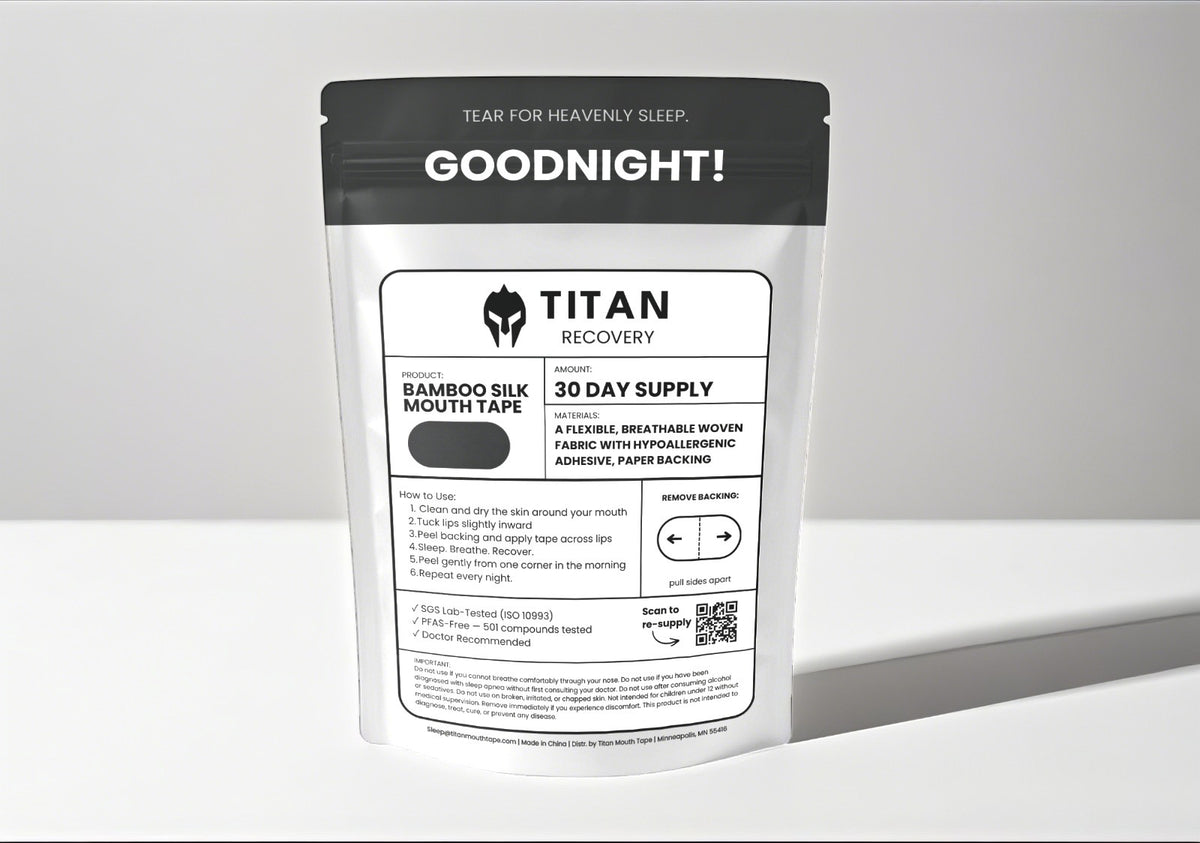
Mild marks or a faint outline that fades within a few minutes are normal and harmless. Lasting redness, irritation, or a rash is not -- that's a sign to stop and reassess your tape or application. A gentle, skin-friendly adhesive like the one on Titan Mouth Tape is designed to peel off cleanly without pulling at sensitive facial skin.
Can I mouth tape if I have a cold or a stuffy nose?
Not while you're actually congested. If you can't move air freely through your nose, skip the tape until the congestion clears. For occasional positional stuffiness, pairing tape with nasal strips helps -- but a full cold is a night to take off.
The Bottom Line
Your first week of mouth taping starts awkward and gets easier fast. Night one will feel unfamiliar, you may wake once, and you might peel the tape off in your sleep without remembering -- all normal. By nights three and four the dry mouth eases, and by the end of the week the tape is usually just part of how you sleep. Prepare by clearing your nose, starting with clean dry lips, and giving yourself full permission to remove it any time.
Use Titan Mouth Tape for a gentle, skin-friendly seal, and add TitanAir Nasal Strips for the first week if congestion is your weak spot. Most people are through the adjustment in 3 to 7 nights. Stop and see a doctor if you feel real breathlessness, can't breathe through your nose upright, or have signs of sleep apnea -- otherwise, give it a full week before you decide.
Doctor Recommended: "As a maxillofacial surgeon and dentist, I recommend Titan Mouth Tape. Nasal breathing during sleep is essential for airway health and deep restorative rest. Titan's bamboo silk design is the most comfortable and effective mouth tape I have tested. If you struggle with snoring, dry mouth, or poor sleep quality, this is the simplest change you can make for your health." — Dr. Francois P., MD, DDS — Maxillofacial Surgeon
Lab-Tested Safety: Titan's adhesive is independently tested to ISO 10993 medical device standards. Non-toxic (95% cell viability). Non-allergenic (0% reaction rate). Non-irritating (score 0.0/8.0). PFAS-free — 501 compounds tested, zero detected. See full test results →
Try the complete system tonight. Titan Mouth Tape (bamboo silk, SilkSeal™ adhesive) + TitanAir Nasal Strips. Free shipping. 30-night Better Sleep Guarantee. Shop Titan Mouth Tape → · Shop TitanAir Nasal Strips →