Your new 5 minute nighttime routine
Share
You've read the sleep hygiene articles. You know the rules. No screens before bed. No caffeine after 2pm. Cool room. Dark room. Consistent bedtime.
You've done all of it. And you're still waking up tired.
Here's the problem with most nighttime routine advice: it focuses entirely on what you do before you fall asleep. It ignores the 7-8 hours after — the hours where your body is either recovering or running in survival mode, depending on one variable nobody talks about.
How you breathe.
This routine takes five minutes. It addresses the before and the during. And it may be the simplest change you make for your sleep this year.
The Routine
Minute 1-2: Wind Down Your Nervous System
Sit on the edge of your bed. Close your mouth. Breathe exclusively through your nose for two minutes.
Inhale for 4 seconds. Hold for 4 seconds. Exhale for 6 seconds. All through the nose.
That's it. No app. No guided meditation. No special technique name. Just slow nasal breathing with a longer exhale than inhale.
Why this works: the extended exhale is associated with parasympathetic nervous system activation — the rest-and-recover branch. Research suggests that slow breathing patterns with longer exhalations may help lower heart rate, reduce cortisol, and signal to your body that it's safe to shift from alert mode to recovery mode. You're not forcing relaxation. You're giving your nervous system the input it needs to downshift on its own.
Two minutes is enough. You'll feel the shift — a subtle heaviness in your limbs, a slower pulse, a quieter mind. If you don't feel it the first night, you'll feel it by the third.
Minute 3: Clear Your Nose
If you have any nasal congestion — even mild — address it now. Not in bed. Not after the lights are off. Now.
Options, depending on what you need:
Mild congestion: A saline rinse or two sprays of saline nasal mist. This clears mucus and hydrates the nasal passages without medication.
Seasonal allergies: If you're in allergy season and your nose is chronically stuffy, a steroid nasal spray (available over the counter) used consistently may help keep the passages open. Talk to your doctor or pharmacist about what's appropriate for you.
Structural restriction: If your nostrils tend to collapse when you inhale, or if your nasal passages are naturally narrow, apply a TitanAir nasal strip across the bridge of your nose. The spring-loaded bands physically lift the nostrils open, reducing resistance and making nasal breathing easier all night.
The goal is simple: make sure air flows comfortably through your nose before you close your mouth. Mouth taping only works if nasal breathing is viable. Sixty seconds of prep ensures it is.
Minute 4: Tape Your Mouth
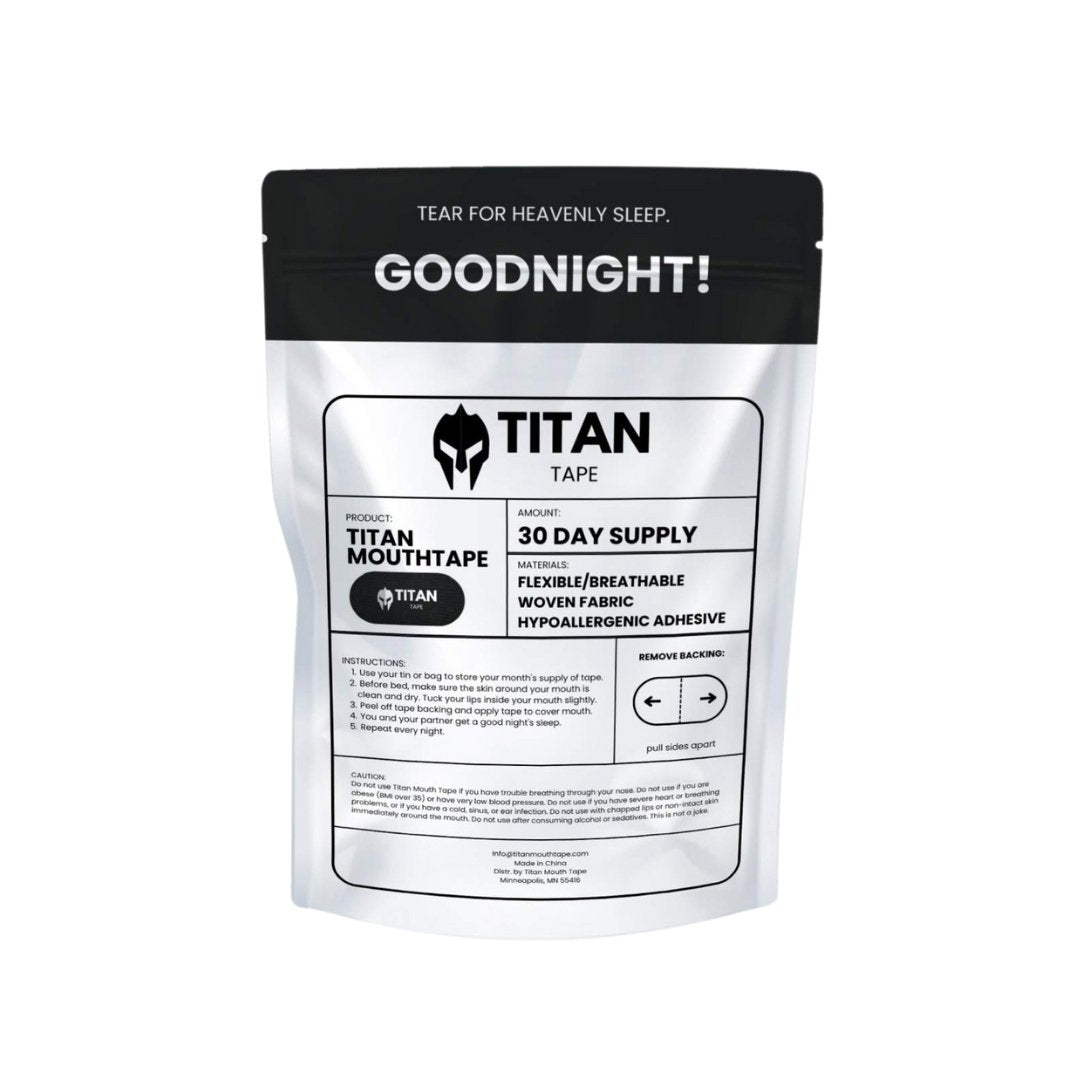
Clean, dry skin around your lips. Tuck your lips slightly inward. Apply one strip of mouth tape across your lips. Press gently for a few seconds to seal.
Five seconds. Done.
This is the step that changes what happens during the next 7-8 hours. With your mouth closed, your tongue rests against the palate. Your airway stays open. Air flows through your nose — where it's filtered, warmed, humidified, and enriched with nitric oxide. Your parasympathetic nervous system stays engaged. Research suggests you may spend more time in the deep sleep stages where growth hormone is released, tissue repairs, and your brain's glymphatic system clears metabolic waste.
Without the tape, your mouth may fall open within the first hour of sleep. Your tongue drops. Your airway narrows. You may start snoring. Your nervous system may shift to sympathetic activation. And you spend the night in a body that's technically sleeping but not fully recovering.
The tape is the difference between those two nights.
Minute 5: Set Your Environment
Lights off. Phone on the charger, face down, across the room if possible. Room temperature between 65-68°F — research consistently shows this range is associated with optimal sleep onset and sleep maintenance.
If you use a white noise machine or fan, turn it on. If you sleep with a partner, this is a good time to mention that you won't be snoring tonight.
That's the routine. Five minutes. Breathe down, clear nose, tape mouth, set environment. In bed by the end of minute five.
Why This Works Better Than "Sleep Hygiene"
Standard sleep hygiene advice isn't wrong. It's just incomplete.
Cutting caffeine helps you fall asleep. Dimming screens helps your melatonin. Cool rooms help your core temperature drop. These are all real, evidence-backed inputs.
But they only affect sleep onset — the first 15-20 minutes. They don't affect the 7+ hours after you're unconscious. And those 7+ hours are where recovery either happens or doesn't.
The breathing component — nasal breathing with your mouth closed all night — addresses the during. It's the variable that determines whether your 7 hours produce deep, restorative sleep or fragmented, survival-mode sleep. And it's the variable that your sleep tracker can't see.
Most nighttime routines take 30-60 minutes — journaling, stretching, meditation, tea, reading, skincare. There's nothing wrong with any of that. But if you only have five minutes, this routine may give you more return per minute than anything else you could do before bed.
What You May Notice
Everyone responds differently. But here's what people commonly report in the first week:
Night 1: Your mouth isn't dry when you wake up. This is usually the first and most obvious change. If you've been waking up with a dry mouth every morning, the first morning without it feels immediately different.
Nights 2-3: Your partner may notice the snoring has stopped or decreased significantly. You may not notice this yourself — but they will.
Nights 4-7: The cumulative effect starts to build. Many people report feeling less groggy in the morning, needing less caffeine, and having more consistent energy in the afternoon. Some notice improvements in workout recovery and gym performance.
Week 2+: The routine becomes invisible. Applying the tape feels as automatic as brushing your teeth. The benefits stop feeling like benefits and start feeling like your new baseline — which is why the one night you forget the tape is usually when you realize how much it's been doing.
Individual results vary. Some people feel a dramatic difference. Others feel a subtle shift. A few feel nothing. But at five minutes a night with zero side effects, the downside risk is essentially zero.
What You Need
The routine requires two things. Three if you have nasal congestion.
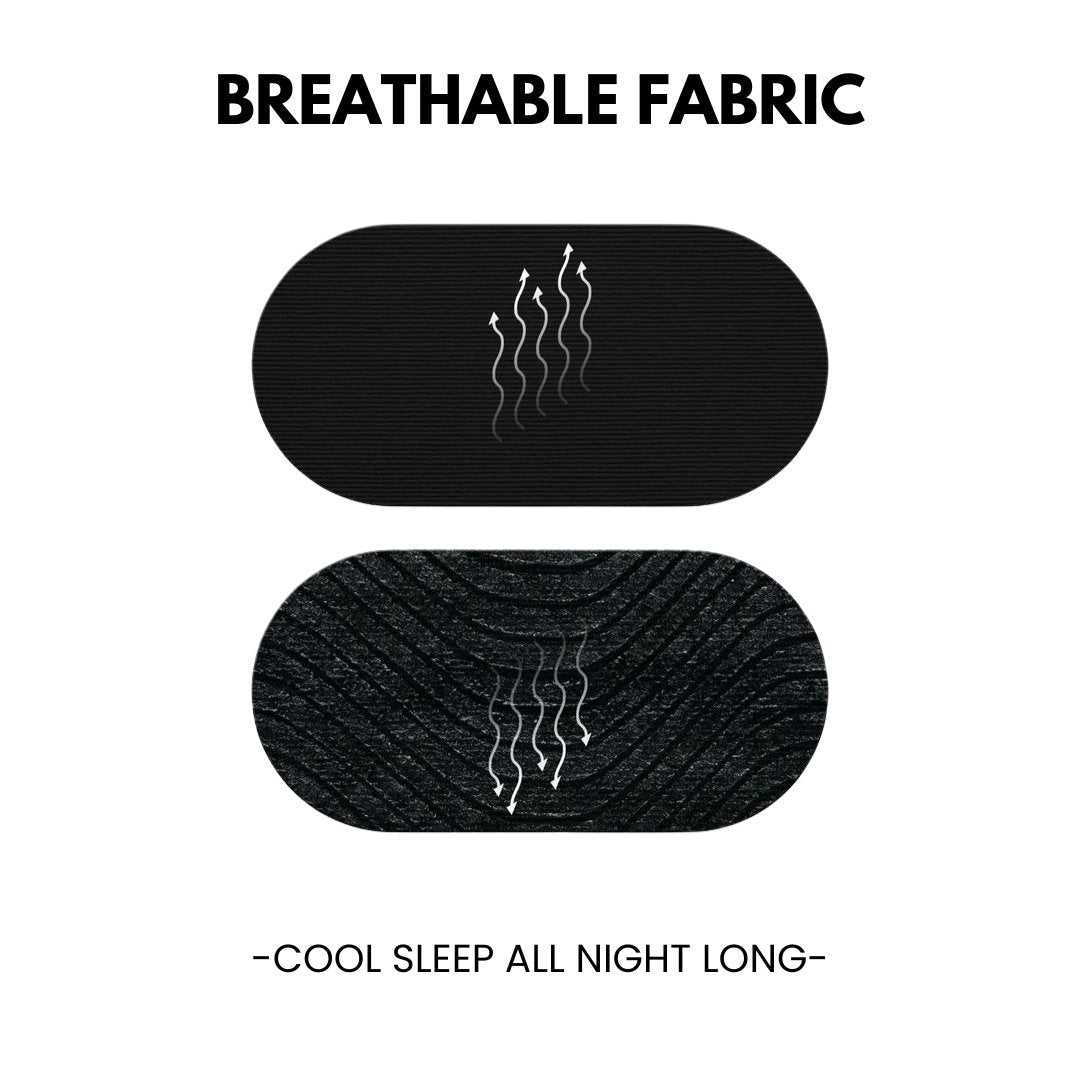
Mouth tape. Use tape designed for sleep — breathable, comfortable, tested for safety. Bamboo silk is ideal. Avoid kinesiology tape, paper tape, or anything not specifically designed for overnight facial use. If you have a beard, make sure the adhesive is designed for facial hair.
TitanAir nasal strips (if needed). If your nose is restricted — from congestion, narrow passages, or nostril collapse — a nasal strip opens the airway mechanically. Apply before the mouth tape. Nose open first, mouth closed second.
Nothing else. No supplements. No devices. No apps. No subscriptions to meditation platforms. Two products that cost less than a dollar a night combined.
Five Minutes Tonight
You spent more time reading this article than the routine takes to do.
Two minutes of slow nasal breathing. One minute clearing your nose. Five seconds taping your mouth. One minute setting your environment.
Five minutes. Then sleep. Then wake up and notice whether something changed.
If it didn't — you lost five minutes. If it did — you found the variable that everything else was missing.
Doctor Recommended: "As a maxillofacial surgeon and dentist, I recommend Titan Mouth Tape. Nasal breathing during sleep is essential for airway health and deep restorative rest. Titan's bamboo silk design is the most comfortable and effective mouth tape I have tested. If you struggle with snoring, dry mouth, or poor sleep quality, this is the simplest change you can make for your health." — Dr. Francois P., MD, DDS — Maxillofacial Surgeon
Lab-Tested Safety: Titan's SilkSeal™ adhesive is independently tested by SGS to ISO 10993 medical device standards. Non-toxic (95% cell viability). Non-allergenic (0% reaction rate). Non-irritating (score 0.0/8.0). PFAS-free — 501 compounds tested, zero detected. REACH compliant — 250 toxic substances screened, all clear. See full test results →
The complete system. Titan Mouth Tape + TitanAir™ Nasal Strips. Five minutes. Two products. Better sleep tonight. Free shipping. 30-night Better Sleep Guarantee. Shop Mouth Tape → · Shop TitanAir →