What Your Sleep Tracker Isn't Telling You
Share
You charge your Whoop every morning. You check your Oura scores before coffee. You've got sleep stages, HRV trends, respiratory rate, skin temperature, and a "readiness score" that tells you whether your body is recovered.
You have more data about your sleep than any generation in human history.
And you're still tired.
What Your Tracker Actually Measures
Let's be honest about what these devices do. They're impressive — but they're limited.
Most consumer sleep trackers measure some combination of movement (accelerometer), heart rate (optical sensor), heart rate variability (HRV), blood oxygen saturation (SpO2), skin temperature, and respiratory rate. From these raw signals, algorithms estimate your sleep stages — light, deep, REM — and calculate scores that summarize your night.
The key word is estimate. The gold standard for sleep measurement is polysomnography — a clinical sleep study with EEG electrodes on your scalp measuring actual brain waves. Your wrist-worn tracker is inferring sleep stages from wrist movement and heart rate patterns. Studies comparing consumer trackers to polysomnography have found that they tend to overestimate total sleep time, underestimate awakenings, and vary significantly in their accuracy of staging — particularly for deep sleep.
This doesn't mean trackers are useless. They're excellent for identifying trends over weeks and months. They're good for spotting patterns — like how alcohol affects your HRV, or how late caffeine shifts your sleep onset. They provide accountability and awareness that most people never had before.
But they have a blind spot. A big one.
The Variable Your Tracker Can't See
No consumer sleep tracker on the market measures how you breathe during sleep.
Not Whoop. Not Oura. Not Apple Watch. Not Garmin. Not Fitbit. Not the Eight Sleep mattress cover. None of them.
They can tell you that your heart rate was elevated between 2am and 4am. They can tell you that your HRV dipped. They can tell you that you spent less time in deep sleep than usual. They can tell you that your blood oxygen dropped slightly.
What they can't tell you is why.
And in many cases, the why is your mouth falling open.
When your mouth opens during sleep, your tongue may drop backward, potentially narrowing your airway. Research suggests this may trigger a shift from parasympathetic (rest) to sympathetic (stress) nervous system activation. Your heart rate may rise. Your HRV may drop. Your body may cycle through micro-arousals that pull you out of deep sleep without fully waking you. Your blood oxygen may dip as breathing becomes less efficient.
Your tracker sees all of these downstream effects. It logs them. It scores them. It tells you that you had a "bad night."
But it doesn't know that the cause was your mouth being open. It just sees the consequences.
The HRV Mystery
HRV — heart rate variability — has become the metric that biohackers obsess over. Higher HRV is generally associated with better recovery, more parasympathetic tone, and greater resilience to stress. Lower HRV may suggest your body is under strain — whether from illness, overtraining, poor sleep, or stress.
If you track HRV, you've probably noticed nights where it drops for no obvious reason. You didn't train hard. You didn't drink. You went to bed on time. Everything was "right." But your HRV tanked.
One possible explanation your tracker can't offer: you mouth-breathed all night. Research suggests mouth breathing is associated with sympathetic nervous system activation, which may suppress HRV. Your body may have spent the night in a low-grade fight-or-flight state — not because of stress or overtraining, but because of how air was entering your body.
The frustrating part is that your tracker will dutifully log the low HRV and give you a poor recovery score. It might suggest you "take it easy today." But it won't tell you that closing your mouth tonight might fix it.
The Deep Sleep Gap
Deep sleep is the metric that matters most for physical recovery. It's when your body may release the majority of its daily growth hormone. It's when tissue repair, muscle recovery, and immune function are believed to be most active. It's the stage your tracker highlights in dark blue and the one you want more of.
Most adults are told to aim for 60-90 minutes of deep sleep per night. Many consistently fall short — logging 20-40 minutes despite adequate total sleep time.
Your tracker tells you how much deep sleep you got. It doesn't tell you what prevented you from getting more.
Research suggests that sleep fragmentation — micro-arousals that pull you out of deeper stages — is one of the primary reasons people don't accumulate enough deep sleep. These micro-arousals can be caused by noise, temperature, pain, or airway obstruction. And one of the most common causes of airway-related micro-arousals is the tongue dropping backward during mouth breathing, potentially creating partial obstruction and triggering brief arousal responses.
You won't remember these micro-arousals. Your tracker might detect some of them as brief "awake" periods. But it can't identify the cause. It just shows you a sleep architecture chart with insufficient deep sleep and no explanation.
The SpO2 Dips Nobody Explains
Some trackers measure blood oxygen saturation (SpO2) overnight. If you've looked at this data, you may have noticed occasional dips — brief drops from your normal 95-99% range down to 90-93% and back up.
Your tracker flags these. Some apps will even alert you to "breathing disturbances" based on SpO2 patterns. But the tracker can't tell you whether those dips came from mouth breathing, positional airway obstruction, or something more significant like sleep apnea.
Here's what the tracker should say but can't: if your SpO2 dips are frequent and significant, see a sleep specialist. If they're mild and occasional, your breathing pattern during sleep — specifically whether your mouth is open or closed — may be a contributing factor worth addressing.
A tracker that detects SpO2 dips without context is giving you data without understanding. It creates anxiety ("is something wrong with me?") without actionable insight ("close your mouth").
The Respiratory Rate Clue Nobody Reads
Most trackers measure respiratory rate — breaths per minute during sleep. Normal adult range is roughly 12-20 breaths per minute during sleep. Most people glance at this number and ignore it.
But respiratory rate may be one of the most telling indicators of how you're breathing.
Nasal breathing naturally creates more airway resistance than mouth breathing. This tends to slow the respiratory rate and may promote deeper, more efficient breathing. Research suggests that nasal breathers tend to have lower respiratory rates during sleep compared to mouth breathers.
If your respiratory rate is consistently at the higher end of normal (17-20 breaths per minute), it may indicate that you're breathing through your mouth — taking faster, shallower breaths instead of the slower, deeper breaths associated with nasal breathing.
Your tracker is logging this data every night. It's right there on the dashboard. But no tracker currently interprets a high respiratory rate as a potential sign of mouth breathing. It's a clue hiding in plain sight.
What to Actually Do With Your Data
Your sleep tracker isn't broken. It's just incomplete. Here's how to use it more effectively:
Run a two-week experiment. Wear your tracker as normal for one week without mouth taping. Log your average HRV, deep sleep duration, respiratory rate, and SpO2 patterns. Then mouth tape (with or without TitanAir nasal strips) for the second week. Compare the same metrics.
Many people who've run this experiment report measurable improvements in HRV, increased deep sleep duration, lower respiratory rates, and fewer SpO2 dips. Individual results vary — but the data is yours to evaluate.
Watch your respiratory rate. If it drops by 1-3 breaths per minute after you start mouth taping, that's a signal that your breathing pattern has shifted from mouth to nasal. Lower and slower may suggest more efficient gas exchange.
Track your morning HRV trend. If your HRV consistently improves on nights you mouth tape versus nights you don't, you've identified a variable your tracker couldn't name but your data confirms.
Stop chasing the score. A "recovery score" is an algorithm's interpretation of sensor data. It's not your body talking to you. Your body talks to you through how you feel when you wake up — energy, clarity, mood, soreness. Use the tracker to confirm what your body already knows, not to override it.
The Missing Input
Sleep trackers are getting better every year. The sensors are more accurate. The algorithms are more sophisticated. Eventually, some device may measure breathing route during sleep — nasal versus oral — and add it to the dashboard.
Until then, there's a gap between what your tracker measures and what actually determines your sleep quality. That gap is how you breathe.
Your tracker can tell you what happened last night. It can't tell you why. And until you control the input it can't see — whether your mouth was open or closed — you're optimizing around incomplete information.
The data says you had a bad night. The fix might be a strip of tape.
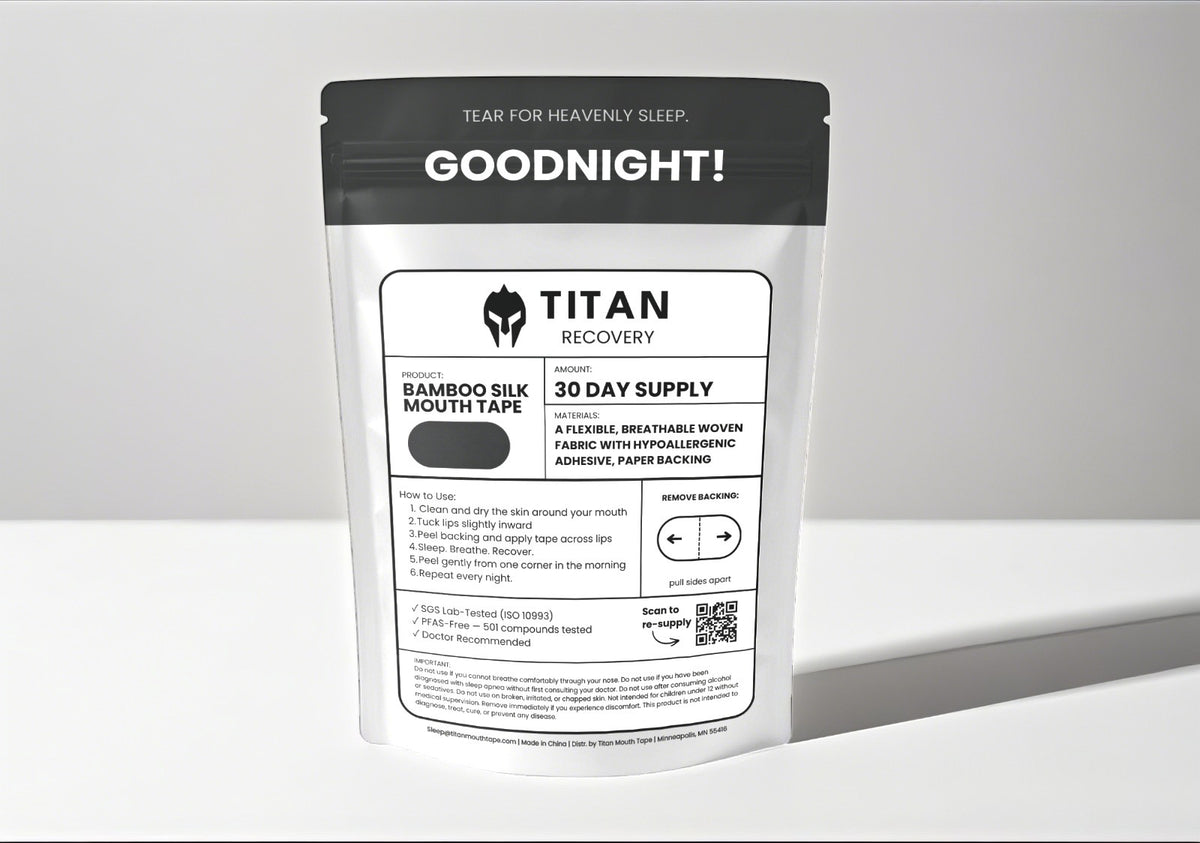
Doctor Recommended: "As a maxillofacial surgeon and dentist, I recommend Titan Mouth Tape. Nasal breathing during sleep is essential for airway health and deep restorative rest. Titan's bamboo silk design is the most comfortable and effective mouth tape I have tested. If you struggle with snoring, dry mouth, or poor sleep quality, this is the simplest change you can make for your health." — Dr. Francois P., MD, DDS — Maxillofacial Surgeon
Lab-Tested Safety: Titan's SilkSeal™ adhesive is independently tested by an independent, globally accredited laboratory to ISO 10993 medical device standards. Non-toxic (95% cell viability). Non-allergenic (0% reaction rate). Non-irritating (score 0.0/8.0). PFAS-free — 501 compounds tested, zero detected. compliant with European chemical safety standards — 250 toxic substances screened, all clear. See full test results →
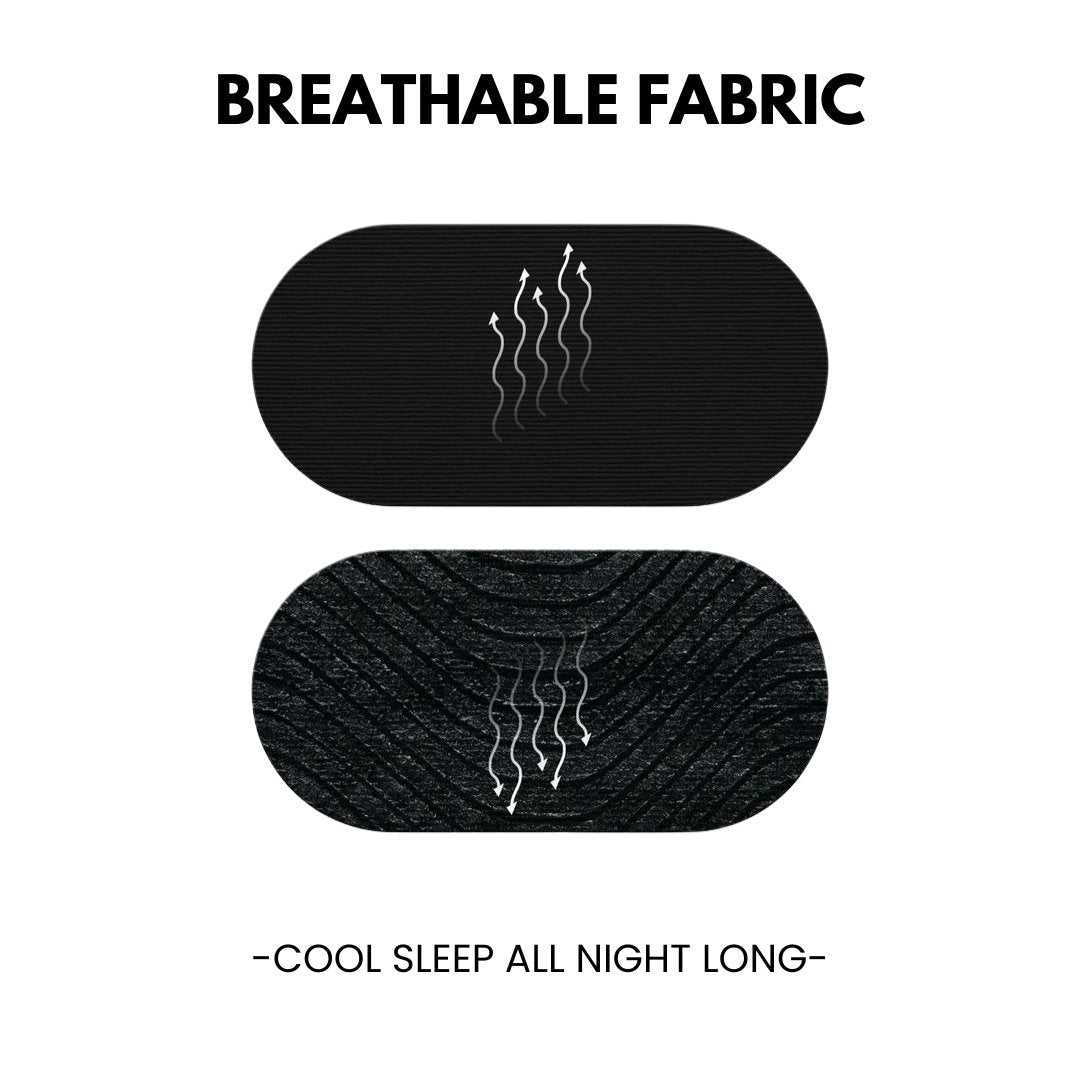
Try it tonight. Bamboo silk mouth tape + TitanAir™ nasal strips. The complete nasal breathing system. Free shipping. 30-night Better Sleep Guarantee. Shop Titan Mouth Tape → · Shop TitanAir →
This article is for informational purposes only and does not constitute medical advice. If you have or suspect a sleep disorder or other medical condition, consult a qualified healthcare provider before making changes to your routine.