Nasal Strips for CPAP Users: Do They Help?
Share
If you run a nasal mask or nasal pillows and your CPAP feels like breathing through a straw some nights, the machine usually isn't the problem -- your nose is. Nasal strips for CPAP can help by mechanically opening your nostrils and lowering the airflow resistance the machine has to push against, which makes nasal-mask therapy more comfortable and reduces the urge to fall back on mouth breathing. What they cannot do is treat sleep apnea. Strips are a comfort aid that sits alongside your prescribed therapy, not a replacement for it.
Here's exactly where nasal strips fit into a CPAP routine, who benefits most, and where they fall short -- with the honest limits spelled out so you know what to expect.
How Nasal Strips Actually Work
Nasal strips open the nose from the outside using simple mechanics. Each strip is an adhesive band with flexible spring-like ribbons inside. When you stick it across the bridge of your nose, those ribbons want to straighten -- and as they do, they gently lift and widen the nostrils, pulling the flexible sidewalls of the nose outward. That widening increases the cross-sectional area of the nasal valve, the narrowest part of your airway, and reduces the resistance air meets on its way in.
There's no drug and no dependency involved. The effect is purely physical, it happens the moment you apply the strip, and it lasts as long as the strip stays on. Research on external nasal dilators has repeatedly shown they reduce nasal airflow resistance. If you want the full mechanism, see how TitanAir nasal strips work and the evidence in do nasal strips work.
Why Nasal Airflow Matters So Much for CPAP
A nasal mask or nasal pillow only works if air can get through your nose. Both of these mask types deliver the machine's pressurized air through your nostrils exclusively -- your mouth stays uncovered. That design assumes a reasonably clear nasal passage. When your nose is partially blocked by congestion, narrow anatomy, or evening swelling, the CPAP is trying to force therapeutic air through a restricted opening.
Two things happen when nasal resistance is high. First, the therapy feels harder -- there's a sensation of pushing against a wall, and some people describe the pressure as "suffocating" even though the machine's numbers are correct. Second, your body looks for the path of least resistance: if the nose is hard to breathe through, your jaw drops and you start mouth breathing. On a nasal mask, that means pressurized air escapes straight out of your open mouth -- a mouth leak -- and the therapy loses its seal.
So nasal resistance isn't a minor comfort detail. It quietly pushes people toward mouth breathing, leak, dryness, and giving up on the machine. Lowering it is where a nasal strip earns its place.
What Nasal Strips Can Do for a CPAP User
Nasal strips address the "air in" side of the equation. For CPAP specifically, that translates into a few concrete benefits.
Lower resistance means more comfortable pressure delivery. When the nasal valve is held open, the machine's air moves through with less effort. For people who find their prescribed pressure hard to tolerate through a congested or narrow nose, a strip can take the edge off the "pushing against a wall" feeling.
Easier nasal breathing reduces the urge to mouth-breathe. This is the most useful thing a strip does for CPAP. If breathing through your nose feels effortless, your body has less reason to open your mouth. That doesn't guarantee your mouth stays shut -- jaw muscles still relax in deep sleep -- but it removes one of the biggest triggers for mouth breathing.
Help during allergy season, colds, and evening congestion. Lying down increases blood flow to the nasal tissues, so many people are more congested at bedtime than during the day. Add allergies or a cold and a nasal mask can feel unusable. A strip provides mechanical opening that can carry you through a stuffy night, a pattern we cover in mouth taping with CPAP.
Drug-free and safe to combine with the machine. Unlike decongestant sprays, strips have no rebound effect and no medication involved. They work purely by holding the nostrils open, so they can be used every night indefinitely.
What Nasal Strips Cannot Do
This is the part that matters most, and it's where a lot of marketing gets dishonest. Be clear on the limits.
Nasal strips do not treat sleep apnea. Obstructive sleep apnea is caused by the airway collapsing at the back of the throat -- behind the tongue and soft palate -- not at the nose. A nasal strip opens the front door; apnea happens in a back hallway the strip never reaches. This is exactly why no adhesive product treats sleep apnea. Only your CPAP delivers the positive pressure that actually holds the throat open.
Nasal strips do not deliver or replace pressure. If you have diagnosed apnea and a prescription for CPAP, you need the machine. A strip cannot generate airflow, cannot splint your airway, and cannot substitute for a single night of therapy.
Nasal strips do not fix structural blockages. A significant deviated septum, nasal polyps, or enlarged turbinates may be too much for an external strip to overcome. Strips help with mild to moderate resistance, not a severe anatomical blockage that needs an ENT.
Nasal strips do not close your mouth. They open the nose, but they leave the mouth free to fall open. That's a real gap for nasal-mask users -- which is where the two-part system below comes in.
The Bigger Picture: Nasal Strips Plus Mouth Tape
Nasal strips and mouth tape solve two different halves of the same problem. The strip handles airflow in -- it opens the nose so the CPAP air has a clear, low-resistance path. Mouth tape handles the leak out -- it holds your lips gently closed so pressurized air can't escape when your jaw relaxes. On a nasal mask, an open mouth is the single most common leak point, and it's the reason so many people wake up parched with a machine that spent half the night ramping up to chase a leak it could never catch.
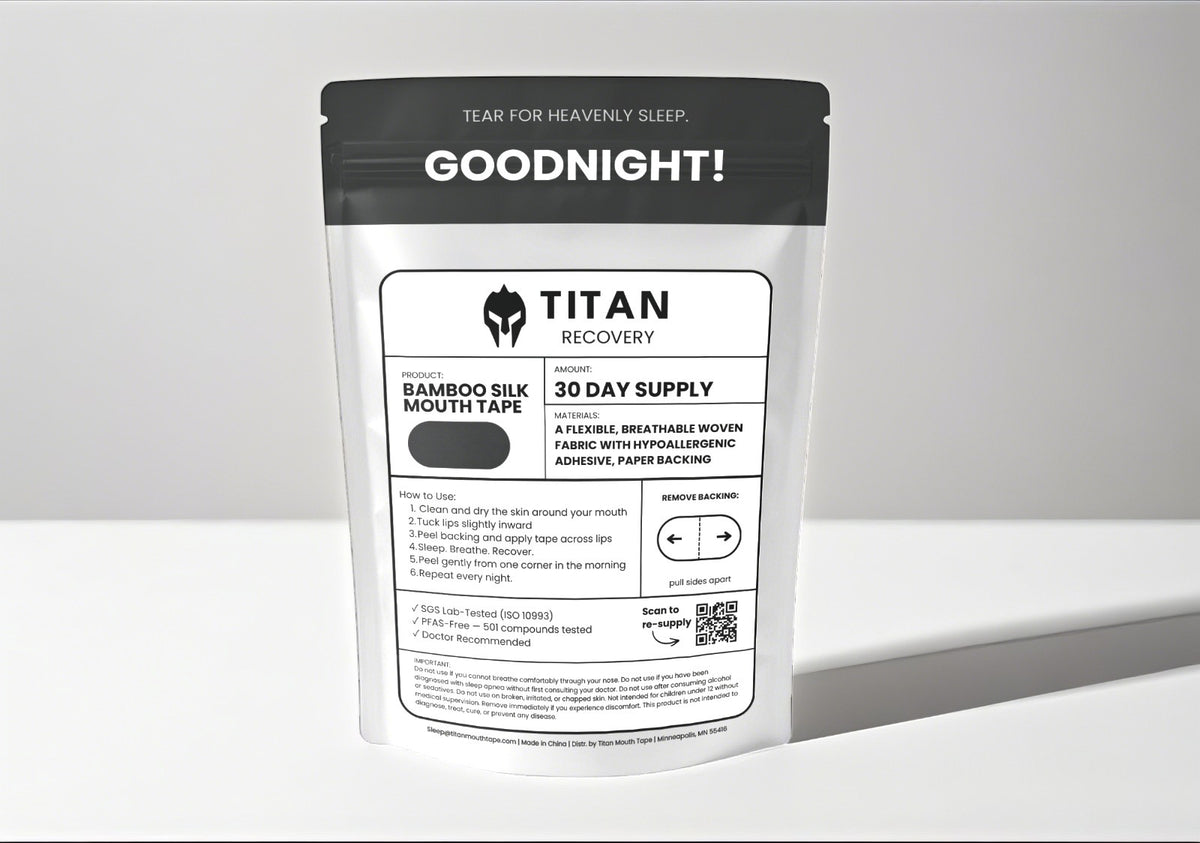
On a nasal-mask or nasal-pillow setup, the logic is clean: TitanAir Nasal Strips open the nose, Titan Mouth Tape seals the mouth, and the CPAP delivers its full pressure through a clear airway with nowhere to leak. The Deep Sleep Bundle pairs both, and the mouth-side mechanics are covered in how mouth tape fixes CPAP mouth leaks.
To be clear about scope: this combination is a comfort and compliance system layered on top of your therapy. It is not itself a treatment, and it doesn't change your diagnosis or your pressure needs.
How to Use Nasal Strips with Your CPAP
Apply the strip before the mask, on clean dry skin. Wash and dry the bridge of your nose -- oils, moisturizer, and sweat all weaken the adhesive. Center the strip so the flexible bands sit over the widest, softest part of your nostrils, then press along the whole length for a few seconds. You should feel your nostrils lift open almost immediately.
Then fit your mask as usual. Position your nasal mask or nasal pillows the way you normally would. The strip sits high on the nose bridge and generally clears the mask seal -- if your cushion overlaps it, adjust placement slightly.
Check your data in the morning. Every modern machine logs leak and pressure data through an app like myAir, DreamMapper, or OSCAR. Compare a few nights with the strip against nights without. If nasal breathing felt easier and your mouth stayed shut more consistently, the strip is doing its job. If congestion only partly responds, ask your specialist about a heated humidifier setting, nasal steroid sprays, or allergy management -- those address inflammation the strip can't.
Talk to Your Sleep Specialist
Your CPAP pressure, mask type, and diagnosis are managed by your sleep doctor -- keep them in the loop. Adding a nasal strip is low-risk, and most specialists have no objection since better nasal airflow tends to help nasal-mask therapy. But your doctor set your pressure and chose your mask, so they should know what you're adding. And if you're congested enough to consider switching mask types or changing settings, that's a conversation for them.
Frequently Asked Questions
Do nasal strips help with CPAP?
They can, for nasal mask and nasal pillow users. Nasal strips open the nostrils and reduce airflow resistance, which can make the machine's pressure more comfortable to breathe against and reduce the urge to mouth-breathe. They don't treat apnea and don't replace the machine -- they're a comfort aid that supports nasal-mask therapy.
Can nasal strips replace my CPAP machine?
No. Nasal strips open the nose but cannot deliver positive pressure or hold your throat open, which is what treats obstructive sleep apnea. If you've been prescribed CPAP, you need the machine every night. Never stop prescribed therapy without your sleep doctor's guidance.
Will a nasal strip help with CPAP nasal congestion?
For mild to moderate congestion -- allergies, a cold, or the swelling that comes from lying down -- a strip can mechanically open the passage enough to keep nasal-mask therapy comfortable. For chronic or severe congestion, or a structural blockage like a deviated septum, see your specialist about humidification, nasal sprays, or an ENT evaluation.
Should I use nasal strips and mouth tape together with CPAP?
On a nasal mask or nasal pillows, the pairing makes sense: the strip opens the nose so air gets in easily, and the tape seals the mouth so pressurized air can't leak out. Together they give the CPAP a clear airway with no leak point. It's a comfort and compliance system, not a treatment -- run it past your sleep specialist first.
Are nasal strips safe to use every night with CPAP?
Yes. Nasal strips are drug-free and work purely by holding the nostrils open, so there's no rebound congestion or dependency the way there is with decongestant sprays. The main limits are skin sensitivity to the adhesive and clean placement that doesn't interfere with your mask seal.
The Bottom Line
Nasal strips for CPAP are a genuinely useful comfort aid for nasal mask and nasal pillow users -- they open the nose, lower resistance, make the prescribed pressure easier to breathe against, and reduce the urge to mouth-breathe that leads to leaks. Paired with mouth tape, they form a simple two-part system: strip for airflow in, tape to stop the leak out, so your machine delivers its full pressure through a clear, sealed airway.
What they are not is a treatment. Nasal strips don't cure apnea, don't replace your machine, and don't fix a serious structural blockage. Use them to make the therapy you were prescribed easier to live with, keep your sleep specialist informed, and let the CPAP do the job only it can do.
Doctor Recommended: "As a maxillofacial surgeon and dentist, I recommend Titan Mouth Tape. Nasal breathing during sleep is essential for airway health and deep restorative rest. Titan's bamboo silk design is the most comfortable and effective mouth tape I have tested. If you struggle with snoring, dry mouth, or poor sleep quality, this is the simplest change you can make for your health." — Dr. Francois P., MD, DDS — Maxillofacial Surgeon
Lab-Tested Safety: Titan's adhesive is independently tested to ISO 10993 medical device standards. Non-toxic (95% cell viability). Non-allergenic (0% reaction rate). Non-irritating (score 0.0/8.0). PFAS-free — 501 compounds tested, zero detected. See full test results →
Try the complete system tonight. Titan Mouth Tape (bamboo silk, SilkSeal™ adhesive) + TitanAir Nasal Strips. Free shipping. 30-night Better Sleep Guarantee. Shop Titan Mouth Tape → · Shop TitanAir Nasal Strips →