Nasal Strips for Congestion, Colds & a Stuffy Nose
Share
When your nose is stuffed up from a cold or a flare of allergies, breathing through it at night feels impossible. You lie down, the congestion gets worse, and within minutes your mouth is open just to get enough air. Nasal strips for congestion help by mechanically widening the nasal valve — the narrowest part of your airway — so you can pull more air through a swollen nose. They don't cure the cold or clear the mucus, but they offset enough of the narrowing to make nighttime nasal breathing possible again when you need it most.
That distinction is the honest core of this guide. A nasal strip is a spring, not a medicine — it opens the door, but it doesn't sweep the room. Knowing exactly what a strip can and can't do is the difference between real relief and disappointment when you just want to sleep.
Why a Stuffy Nose Feels Worse at Night
If your congestion is tolerable during the day but unbearable the moment your head hits the pillow, you're not imagining it. Several things stack up after dark.
Gravity works against you. Lying flat, blood pools in the upper body and flows more freely into the nasal tissues. The turbinates — the soft, spongy structures inside your nose — swell further, and a passage that felt half-open at your desk can feel fully sealed in bed. Mucus that drained downward while you were upright now collects in the passages, adding a fluid layer on top of the swelling.
Your reflexes switch off. During the day you sniff, swallow, and adjust your breathing without noticing. Asleep, those compensations stop, and if nasal resistance is high your body opens your mouth — drying your throat, worsening the cough, and fragmenting your sleep. This is the exact window where a nasal strip earns its place: steady mechanical support all night, without requiring you to wake up and do anything about it.
How Nasal Strips Help When You're Congested
A nasal strip is an adhesive band with flexible splints built in. Applied across the bridge of your nose, those splints act like a spring, lifting the sidewalls of your nostrils outward and pulling open the nasal valve — the narrowest, most collapse-prone point in the airway.
Here's why that helps a congested nose specifically. When your passages are swollen, breathing in creates extra suction that pulls the flexible nostril walls inward — the harder you inhale, the more the valve collapses on top of the internal swelling. A strip holds that valve open against the suction, so you fight only the internal congestion instead of two problems at once.
The effect is immediate. Unlike a decongestant that takes time to shrink tissue, a strip works the moment you apply it. Research on external nasal dilators has shown measurable reductions in nasal airway resistance and improvements in how easily people feel they can breathe. For a mild-to-moderate stuffy nose, that's often enough to keep you breathing through your nose all night instead of switching to your mouth.
If you want the full mechanical breakdown, we cover it in how TitanAir nasal strips work and in our overview of whether nasal strips actually work.
The Honest Limit: What Nasal Strips Can't Do
This is the part most product pages skip, and it's the most important thing to understand before you rely on a strip during a cold.
They do not reduce mucus. They don't dry up a runny nose, thin thick secretions, or clear pooling fluid. If congestion is mostly mucus rather than tissue swelling, a strip helps less because it can't move liquid out of the way.
They do not treat infection or inflammation. A cold is a viral infection; allergies are an immune response. A strip does nothing to the underlying cause — it won't shorten a cold, kill a virus, or calm inflammation. It only changes the geometry of your outer airway.
They only reach the valve. The lift is at the front of your nose. If your blockage is deep — high in the sinuses or far back in the nasal cavity — an external strip can't reach it. It opens the entrance, not the whole hallway.
So a nasal strip is one layer of a congestion strategy, not the whole thing. It offsets valve-level narrowing so the air that can get through, does. For everything deeper or wetter, you need other measures alongside it.
When Nasal Strips Help Most (and When They Won't)
Matching the tool to the problem separates relief from frustration.
They help most when: your congestion is mild to moderate, your nostrils feel like they're caving in when you inhale hard, and the narrowing is at or near the nasal valve. That describes a lot of head colds, allergy flares, and the positional stuffiness that hits when you lie down. If you can get some air through your nose but it feels tight and effortful, a strip usually makes a noticeable difference.
They won't do much when: both nostrils are completely sealed, your congestion is almost entirely thick mucus, or the blockage is a deep sinus issue rather than a valve issue. If you can't move any air through your nose no matter how you position it, an external strip has nothing to work with — bring the swelling or mucus down first. A quick self-test: apply the strip and breathe in slowly with your mouth closed. If airflow goes from "impossible" to "tight but workable," it's doing its job; if nothing changes, the blockage is deeper than a strip can reach.
The Practical Combo: Strips Plus Steam, Saline, and Elevation
Because a strip only addresses the valve, the smart move during a cold is to pair it with measures that tackle the mucus and swelling it can't touch.
Steam first. Warm, moist air from a hot shower or a bowl of steaming water loosens thick mucus and soothes irritated passages, so you can clear your nose before you lie down.
Rinse with saline. A saline rinse or spray flushes mucus and allergens out of the nasal passages and adds moisture, so the airway the strip holds open is actually clear, not just wider.
Elevate your head. An extra pillow, or raising the head of the bed, uses gravity to keep blood and mucus from pooling in your nose — directly countering the main reason congestion worsens at night.
Then apply the strip. With the mucus loosened, the passages rinsed, and your head raised, the strip does the last job: keeping the valve open so the airflow you just cleared stays available all night, without you having to get up.
Why Nasal Breathing Still Matters During a Cold
It's tempting to just give up and breathe through your mouth when you're sick. But nasal breathing does real work that matters even more when your body is fighting something off.
Your nose filters, warms, and humidifies air before it reaches your lungs. Mouth-breathing through a cold skips all of that — cold, dry, unfiltered air hits an already-irritated throat, which is why you wake with a raw, sandpaper throat and a worse cough than you went to bed with. Nasal breathing keeps the airway moist and helps you avoid the secondary problems mouth breathing piles on being sick: dry mouth, cracked lips, louder snoring, and fragmented sleep that slows recovery. You won't always manage full nasal breathing when congested, and that's fine — but keeping as much of it as you can is worth the effort. Our guides on how to breathe through your nose while sleeping and how to sleep better go deeper on building the habit.
A Note on Mouth Tape When You're Blocked
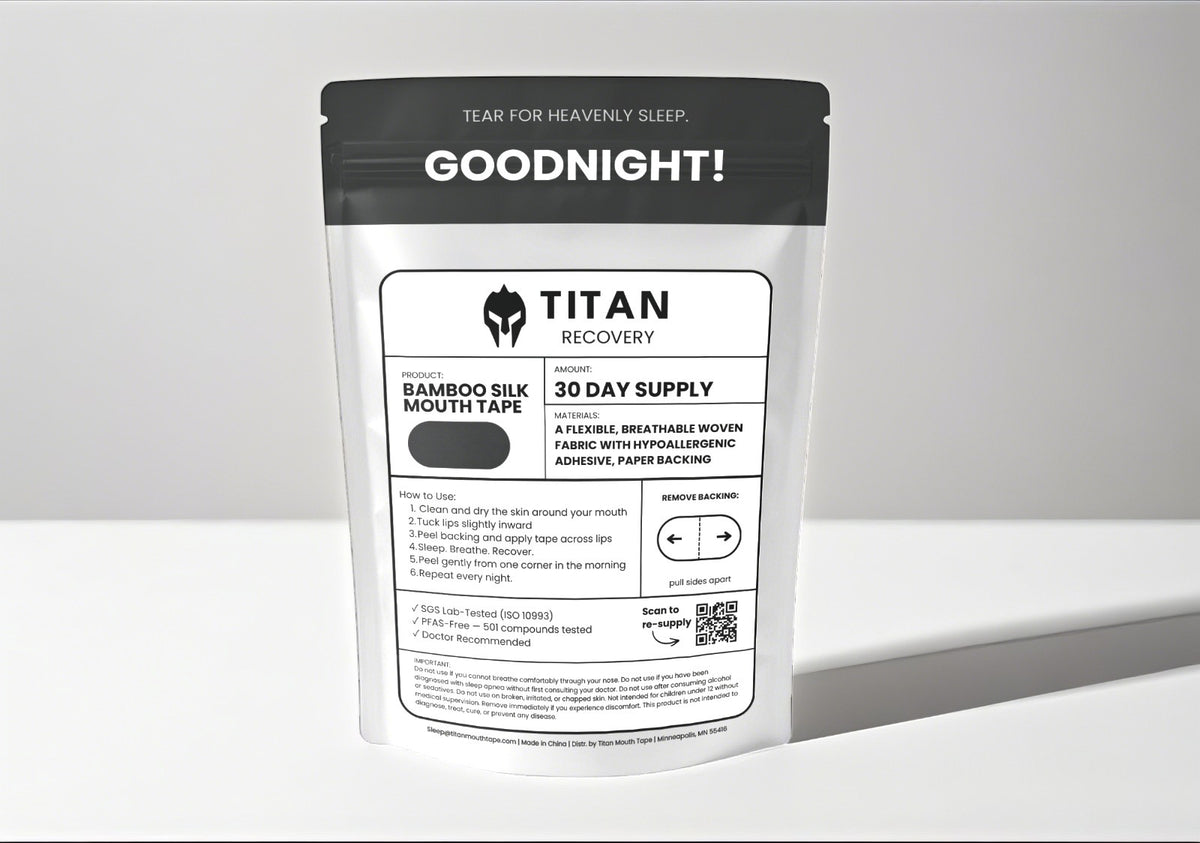
We make mouth tape, and we'll be straight with you: mouth taping isn't always the right call when you're fully congested. Mouth tape keeps your lips closed so your body uses the nasal airway — which only works if that airway is actually open. If your nose is completely blocked, taping your mouth removes your backup airway, and you'll just wake up and pull it off.
The right sequence is to open the nose first, then decide. Apply the TitanAir Nasal Strip, use your steam and saline, and take a few breaths with your mouth closed. If nasal breathing feels genuinely comfortable, add the tape. If your nose still feels too restricted, skip the tape that night and use the strip alone — during the worst days of a cold, the strip on its own is often the right tool, with tape returning once you can breathe freely. The Titan Deep Sleep Bundle gives you both so you can adapt night to night.
Frequently Asked Questions
Do nasal strips actually work for a stuffy nose?
Yes, for the right kind of stuffiness. Nasal strips widen the nasal valve at the front of your nose, which reduces airway resistance and helps you pull more air through swollen passages. They work best for mild-to-moderate congestion where the narrowing is at or near the valve. They do less for congestion driven mainly by thick mucus or by a deep sinus blockage, because the strip only reaches the outer airway.
Can I use nasal strips when I have a cold?
Absolutely. A nasal strip is a non-medicated adhesive device, so it won't interact with any cold or allergy medication you're taking. Use it alongside steam, a saline rinse, and an elevated head position for the best result. Just remember the strip opens the valve — it won't shorten the cold or clear the mucus, so pair it with those other measures rather than relying on it alone.
Why doesn't my nasal strip help when I'm completely blocked?
If both nostrils are fully sealed, there's no open channel for the strip to hold open. An external strip lifts the sidewalls of your nose, but it can't force air through a passage that's completely swollen shut or packed with mucus. Bring the congestion down first with steam, a saline rinse, or a decongestant your doctor recommends, then apply the strip to keep the newly cleared airway open through the night.
Should I use mouth tape if my nose is congested?
Only if you can breathe comfortably through your nose after opening it up. Mouth tape keeps your lips closed so you breathe nasally, which requires a working nasal airway. If you're fully blocked, taping removes your only remaining airway and won't be comfortable. Apply a nasal strip first, clear your nose, and test your breathing. If it feels good, add the tape; if not, use the strip alone until the congestion eases.
How long can I wear a nasal strip overnight?
A nasal strip is designed for a full night of sleep, seven to nine hours, then removed in the morning. There's no rebound effect or tolerance buildup the way there is with medicated decongestant sprays, so you can use one nightly for as long as your congestion lasts. Apply to clean, dry skin and remove gently.
The Bottom Line
A stuffy nose steals the sleep you need most when you're fighting a cold. Nasal strips help by widening the nasal valve to offset some of the swelling, making nighttime nasal breathing possible when it otherwise wouldn't be — a real, immediate benefit that comes with an honest limit: strips open the valve, but they don't clear mucus or treat the infection underneath.
The way to get the most from them is to stack them: steam and saline for the mucus, an elevated head for the positional swelling, and a TitanAir Nasal Strip to keep the airway open all night. Add mouth tape only once your nose is clear enough to breathe through comfortably. Do that, and even a bad cold night can become one you actually sleep through.
Doctor Recommended: "As a maxillofacial surgeon and dentist, I recommend Titan Mouth Tape. Nasal breathing during sleep is essential for airway health and deep restorative rest. Titan's bamboo silk design is the most comfortable and effective mouth tape I have tested. If you struggle with snoring, dry mouth, or poor sleep quality, this is the simplest change you can make for your health." — Dr. Francois P., MD, DDS — Maxillofacial Surgeon
Lab-Tested Safety: Titan's adhesive is independently tested to ISO 10993 medical device standards. Non-toxic (95% cell viability). Non-allergenic (0% reaction rate). Non-irritating (score 0.0/8.0). PFAS-free — 501 compounds tested, zero detected. See full test results →
Try the complete system tonight. Titan Mouth Tape (bamboo silk, SilkSeal™ adhesive) + TitanAir Nasal Strips. Free shipping. 30-night Better Sleep Guarantee. Shop Titan Mouth Tape → · Shop TitanAir Nasal Strips →