Does Mouth Taping Change Your Face? What’s Real and What’s Hype
Share
The before-and-after photos are everywhere. TikTok. Reddit. YouTube. Someone tapes their mouth shut for 30 days and posts a side-by-side showing a sharper jawline, less facial puffiness, and a more defined chin.
Then the comments split into two camps: "this changed my face" and "this is complete BS."
The truth is somewhere in between — and the answer depends on what you mean by "change your face."
The Short Answer
Mouth taping does not reshape your skull. It does not move bones. It is not a substitute for orthodontics, surgery, or genetics.
But mouth taping — specifically, the switch from mouth breathing to nasal breathing during sleep — may produce visible changes in facial appearance through mechanisms that have nothing to do with bone structure. These changes are real, documented in research, and consistently reported by users. They're just not what most people think they are.
What Actually Changes (And Why)
1. Facial puffiness decreases
This is the most immediate and visible change — and the one driving most of the TikTok before-and-after content.
Mouth breathing during sleep is associated with sympathetic nervous system activation — the stress response. Research suggests chronic sympathetic activation may contribute to fluid retention and impaired lymphatic drainage in facial tissues. The result: a puffy, swollen-looking face in the morning that takes hours to resolve.
Nasal breathing is associated with parasympathetic activation — the rest-and-recovery state. When your nervous system is in recovery mode during sleep, lymphatic drainage may function more efficiently, reducing the fluid buildup that causes morning puffiness.
This isn't a structural change. It's a fluid change. But the visual difference — especially around the jawline, under the eyes, and in the cheeks — can be significant enough to look like a different face in photographs. And it can happen within the first few days of mouth taping.
2. Under-eye darkness and bags reduce
Dark circles under the eyes have multiple causes — genetics, pigmentation, thin skin, allergies. But one of the most common contributors is poor sleep quality.
When deep sleep is fragmented or shortened — as research suggests may happen with mouth breathing — blood vessels beneath the thin under-eye skin dilate, creating the dark, shadowed appearance. Fluid also pools in the under-eye area due to impaired drainage during low-quality sleep.
Better sleep quality from nasal breathing may reduce both the vascular dilation and the fluid pooling. Users commonly report that under-eye circles lighten and bags diminish within 1-2 weeks of consistent mouth taping — not because the tape treats the eyes, but because the sleep quality improvement addresses one of the underlying causes.
3. Jawline appears more defined
This is the change that gets the most attention — and the most debate.
Two mechanisms may contribute:
Reduced puffiness reveals existing bone structure. If your face carries excess fluid from chronic mouth breathing, reducing that fluid reveals the jawline that was already there. You didn't grow a new jaw. You uncovered the one you had.
Masseter muscle tone may increase. When your mouth stays closed during sleep, the masseter muscles (the jaw muscles you use to clench and chew) maintain low-level engagement throughout the night. Over weeks and months, this sustained engagement — similar to any muscle under consistent tension — may contribute to slightly more defined jaw contours.
This isn't the same as building muscle in a gym. The effect is subtle. But for people whose jaw muscles have been chronically relaxed from years of open-mouth sleeping, the restoration of resting tone can produce a visible difference — especially in combination with reduced facial puffiness.
4. Lip hydration improves
When your mouth is open during sleep, your lips dry out. Eight hours of airflow across the lip surface dehydrates the tissue, leading to chronic cracking, peeling, and that perpetually dry appearance that no lip balm seems to fix during the day.
When your mouth stays closed, your lips retain their natural moisture all night. Lip balm or treatment applied before bed stays on the lips instead of evaporating into a stream of dry air. Within days, lips appear more hydrated, smoother, and less cracked — without changing any lip care products.
5. Forward head posture may improve
Chronic mouth breathing is associated with forward head posture — the head drifts forward to open the airway as a compensatory mechanism. This postural adaptation changes how the face and neck look from the side: the chin appears recessed, the neck looks shorter, and the jawline loses definition.
Research from the orthodontic literature documents this relationship in both children and adults. When mouth breathing is addressed and nasal breathing is restored, some individuals experience a gradual improvement in head posture over weeks to months. The chin comes back. The neck looks longer. The jaw looks more defined — not because the jaw changed, but because the head moved back to its natural position.
What Doesn't Change
Bone structure. In adults, the bones of the skull are fused. Mouth taping does not widen the palate, advance the maxilla, or reshape the mandible. Claims that mouth taping produces skeletal changes in adults are not supported by peer-reviewed research. The mewing community debates this, and some practitioners propose soft tissue remodeling over extended periods — but the clinical evidence for adult skeletal change from posture alone is limited.
Genetic facial features. Your cheekbone height, nose shape, eye spacing, and basic facial proportions are determined by genetics and skeletal structure. Mouth taping doesn't alter these.
Significant weight-related facial fullness. If facial fullness is primarily from body fat rather than fluid retention, mouth taping won't produce a dramatic change in facial appearance. Weight loss is the intervention for fat-related facial changes.
Why the Before-and-After Photos Look So Dramatic
Several factors make the TikTok transformations look more dramatic than the underlying changes:
Lighting and angle differences. Many before-and-after comparisons aren't taken in identical conditions. Different lighting, different angles, different times of day. Morning puffiness in the "before" vs. evening leanness in the "after" can create a dramatic contrast that overstates the actual change.
Multiple variables changing simultaneously. People who start mouth taping often simultaneously improve their sleep hygiene, reduce alcohol, drink more water, and pay more attention to their health overall. The facial changes may come from the combination — not mouth taping alone.
The puffiness reduction is real and immediate. Even accounting for photo inconsistencies, the fluid reduction from switching to nasal breathing is genuine and often significant. For someone who's been chronically puffy from years of mouth breathing, the change in the first week can be genuinely striking.
Confirmation bias. People who tape their mouth expecting facial changes are primed to notice them. This doesn't mean the changes aren't real — but it means the perceived magnitude may be amplified by expectation.
What the Research Says
The peer-reviewed evidence supports several of the mechanisms described above, with important caveats:
Mouth breathing and facial development in children: Well-documented. Research by Harvold et al. (1981), published in the American Journal of Orthodontics, demonstrated that induced mouth breathing in primates produced measurable craniofacial changes — longer face, narrower dental arches, recessed chin. Pediatric research consistently links chronic mouth breathing with "long face syndrome."
Mouth breathing and facial appearance in adults: Less studied. The research suggests that soft tissue changes (puffiness, muscle tone, posture) are plausible and consistent with reported user experiences, but large-scale controlled studies specifically measuring adult facial changes from mouth taping have not been published as of mid-2026.
Nasal breathing and autonomic nervous system: Well-documented. The parasympathetic activation associated with nasal breathing is established in the literature (Neuroreport). The downstream effects on fluid retention and lymphatic drainage are biologically plausible and consistent with clinical observations, though direct causation studies specific to facial puffiness are limited.
Sleep quality and facial appearance: Well-documented. Research published in the journal Sleep found that sleep-deprived individuals were rated as looking more fatigued, less healthy, and less attractive by blinded observers. The connection between sleep quality and facial appearance is established — and mouth taping's effect on sleep quality is the likely pathway for the facial changes users report.
How to See for Yourself
The only way to know whether mouth taping changes your face is to test it on your own face. Here's how to do it properly:
Take a baseline photo. Same lighting, same angle, same time of day (morning, before any skincare or water). Front view and profile. Use a plain background.
Tape your mouth every night for 30 days. Don't change anything else — same diet, same exercise, same skincare. Isolate the variable.
Take a comparison photo on day 30. Same conditions as the baseline. Compare side by side.
Notice the non-visual changes too. Dry mouth gone? Snoring reduced? Morning energy improved? The facial changes are a secondary benefit. The sleep quality improvement is the primary one — and it's the one you'll notice most in your daily life.
The Honest Take
Does mouth taping change your face? It may change how your face looks — through reduced puffiness, improved under-eye appearance, better lip hydration, subtle jaw muscle tone, and improved posture. These changes are real, consistent with physiology, and widely reported.
It doesn't change your facial structure, your bone geometry, or your genetics. Anyone claiming mouth tape will give you a new face is overpromising.
But looking less puffy, less tired, and more defined after a month of better sleep? That's not a stretch. That's what happens when you stop mouth breathing away your recovery for 8 hours every night.
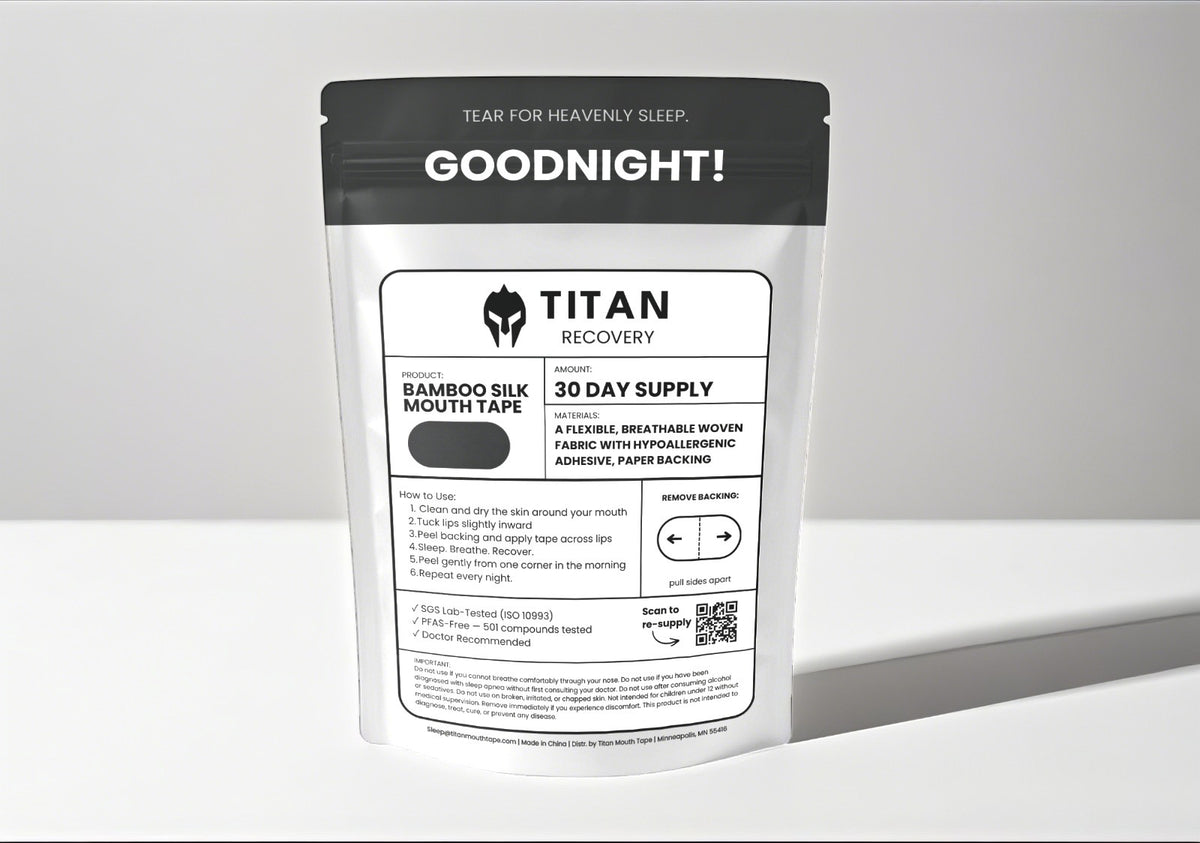
Doctor Recommended: "As a maxillofacial surgeon and dentist, I recommend Titan Mouth Tape. Nasal breathing during sleep is essential for airway health and deep restorative rest. Titan's bamboo silk design is the most comfortable and effective mouth tape I have tested. If you struggle with snoring, dry mouth, or poor sleep quality, this is the simplest change you can make for your health." — Dr. Francois P., MD, DDS — Maxillofacial Surgeon
Lab-Tested Safety: Titan's adhesive is independently tested to ISO 10993 medical device standards. Non-toxic (95% cell viability). Non-allergenic (0% reaction rate). Non-irritating (score 0.0/8.0). PFAS-free — 501 compounds tested, zero detected. See full test results →
Try it tonight. Bamboo silk. SilkSeal™ adhesive. Beard-friendly. No logo on the tape. Free shipping. 30-night Better Sleep Guarantee. Shop Titan Mouth Tape → · Shop TitanAir →