Best Nasal Strips for Snoring (2026 Guide)
Share
If you've been searching for the best nasal strips for snoring, you're already on the right track. Snoring affects roughly half of all adults at some point in their lives, and it does more damage than most people realize. It fragments your sleep. It fragments your partner's sleep. Over time, the chronic mouth breathing that drives most snoring degrades everything from your energy to your oral health.
The good news: nasal strips are one of the simplest, most accessible tools for reducing snoring. No prescriptions. No devices. No surgery. Just a small adhesive strip that mechanically opens your nasal passages and lets more air through. But not all nasal strips are equal, and most people don't understand how they actually work or what to look for when choosing one. This guide covers all of it.
How Nasal Strips Actually Reduce Snoring
The mechanism is purely physical. A nasal strip is an adhesive bandage with one or more flexible splints embedded inside. You apply it across the bridge of your nose, and the splints gently lift the sidewalls of the nostrils outward. This widens the nasal valve — the narrowest point of the nasal airway — and reduces resistance to airflow.
Research published in rhinology journals has consistently shown that external nasal dilator strips reduce nasal airway resistance and improve airflow volume. When air moves through the nose more easily, the body has less reason to default to mouth breathing during sleep.
Why does that matter for snoring? Most snoring originates in the throat, not the nose. When the mouth opens during sleep, the jaw drops, the tongue falls backward, and the soft tissues at the back of the throat narrow the airway. Air pushing through that narrowed space vibrates the tissue — that vibration is the sound of snoring.
Nasal strips attack the problem upstream. By making nasal breathing easier and more efficient, they reduce the likelihood that your body will switch to mouth breathing as you fall into deeper sleep stages. Less mouth breathing means the tongue stays forward, the airway stays open, and the tissue vibration that produces snoring is reduced.
That said, nasal strips work best for snoring that's driven by nasal congestion or restriction. If you have snoring related to obstructive sleep apnea, nasal strips alone won't resolve it — talk to your doctor.
What to Look for in Nasal Strips for Snoring
Not every nasal strip on the shelf is worth your money. Here are the criteria that actually matter.
Splint strength and design. The flexible bands inside the strip are what do the work. Too weak and the strip barely lifts the nostrils. Too rigid and it's uncomfortable and leaves marks. Look for strips with spring-loaded splints that hold their shape all night without digging into your skin.
Adhesive quality. A nasal strip is useless if it peels off at 2 AM. The adhesive needs to hold through a full night of sleep, including any sweating or movement, without irritating sensitive facial skin. Medical-grade, hypoallergenic adhesive is the standard to look for — especially if you're using strips every night.
Skin safety and materials. You're wearing this product on your face for 7-8 hours. The materials should be dermatologist-tested, free of latex, and free of unnecessary fragrances or dyes. Third-party testing for biocompatibility (ISO 10993 is the international standard) is a meaningful differentiator — most brands don't bother.
Fit and sizing. Noses vary. A strip designed for one nose shape won't work universally. The best nasal strips for snoring come in sizes that account for different nose widths and bridge profiles so the splints land on the right spot to maximize lift.
PFAS-free construction. Per- and polyfluoroalkyl substances (PFAS) are used in some adhesive products for moisture resistance. They're persistent environmental contaminants and have been linked to health concerns. Your nasal strip should be PFAS-free — check the label or the brand's testing documentation.
Nasal Strips Compared
| Feature | TitanAir | Breathe Right | Generic / Store Brand |
|---|---|---|---|
| Spring-loaded splints | ✓ | ✓ | Varies |
| Hypoallergenic adhesive | ✓ | ✓ | Varies |
| Third-party tested (ISO 10993) | ✓ | Not published | ✗ |
| PFAS-free | ✓ | Not disclosed | Not disclosed |
| Latex-free | ✓ | ✓ | Varies |
| Stays on all night | ✓ | ✓ | Sometimes |
| Designed specifically for sleep | ✓ | General use | General use |
Why We Built TitanAir Nasal Strips
We built TitanAir Nasal Strips because we were already making mouth tape and saw the same pattern over and over: customers would ask whether they needed a nasal strip too, then go buy a drugstore brand that was designed for general use, not specifically for sleep.
The nasal strips on the market work. We're not going to pretend they don't. But most of them were designed decades ago, and the category hasn't been meaningfully updated. We saw room to build something better — purpose-built for nightly sleep use, with the kind of material standards we already hold ourselves to for our mouth tape.
Here's what that looks like in practice:
Every batch of TitanAir strips is third-party tested to ISO 10993, the international biocompatibility standard. The adhesive is medical-grade, hypoallergenic, and latex-free. The materials are verified PFAS-free. The splints are calibrated to provide enough lift to open the nasal valve without leaving red marks or causing discomfort over a full night of wear.
We designed TitanAir strips to work as a standalone product for people whose snoring is primarily nasal in origin. But we also designed them to pair with our mouth tape for people who want to train themselves to breathe through their nose at night. The nasal strip opens the airway. The mouth tape keeps it as the only airway. Together, they create a complete nasal breathing system.
If you've been wondering, "do nasal strips help with snoring?" — yes, they can. The research supports the mechanism, and the real-world results our customers report back are consistent with that research. They won't cure every type of snoring. But for snoring driven by nasal congestion, narrow nostrils, allergies, or general nasal resistance, a good nasal dilator strip can make a meaningful difference.
Getting the Most Out of Nasal Strips
Clean and dry your nose first. Oil, moisturizer, or sweat on the skin will weaken the adhesive bond. Wash the bridge of your nose and dry it completely before application.
Place the strip correctly. The strip should sit across the widest part of your nostrils, not too high on the bony bridge and not too low near the tip. When placed correctly, you'll feel an immediate opening sensation as the splints engage.
Press firmly for 10 seconds. This gives the adhesive time to bond with your skin and ensures the strip stays put through the night.
Consider pairing with mouth tape. Nasal strips for snoring work by opening the nose, but they don't prevent your mouth from opening. If mouth breathing is part of your snoring pattern — and for most snorers it is — adding mouth tape addresses the other half of the equation. Our Deep Sleep Bundle includes both products and is the most cost-effective way to build the habit.
Remove gently in the morning. Peel from one side slowly. If you have sensitive skin, a warm washcloth held against the strip for a few seconds will loosen the adhesive before removal.
When Nasal Strips Are Not Enough
Nasal strips are effective for a wide range of people. But they have limits, and being honest about those limits matters.
If your snoring is loud, persistent, and accompanied by pauses in breathing, gasping, or excessive daytime sleepiness, you may be dealing with obstructive sleep apnea rather than simple snoring. Knowing the difference between snoring and sleep apnea is important — sleep apnea requires medical evaluation and treatment. Nasal strips are not a treatment for sleep apnea.
Similarly, if you have severe nasal obstruction from polyps, significant septal deviation, or chronic sinusitis, a nasal strip may not provide enough mechanical opening to resolve the restriction. See an ENT for structural issues that a strip can't compensate for.
For the large population of people whose snoring is driven by mild to moderate nasal restriction, congestion, allergies, or positional mouth breathing — nasal dilator strips for snoring are a legitimate, evidence-supported, drug-free tool that works from the first night.
The Bottom Line
The best nasal strips for snoring are the ones that actually stay on all night, open your nasal passages effectively, and don't compromise on material safety. That's what we built TitanAir to be — a strip that's purpose-designed for sleep, third-party tested for biocompatibility, and effective enough to make a real difference in how you breathe at night. For a broader look at all the options, see our full guide to the best nasal strips for sleeping.
If nasal congestion or restriction is contributing to your snoring, start with TitanAir Nasal Strips. If mouth breathing is part of the picture too, grab the Deep Sleep Bundle and address both sides at once. Either way, you're making a simple, drug-free change that can improve how you breathe and how you sleep starting tonight.
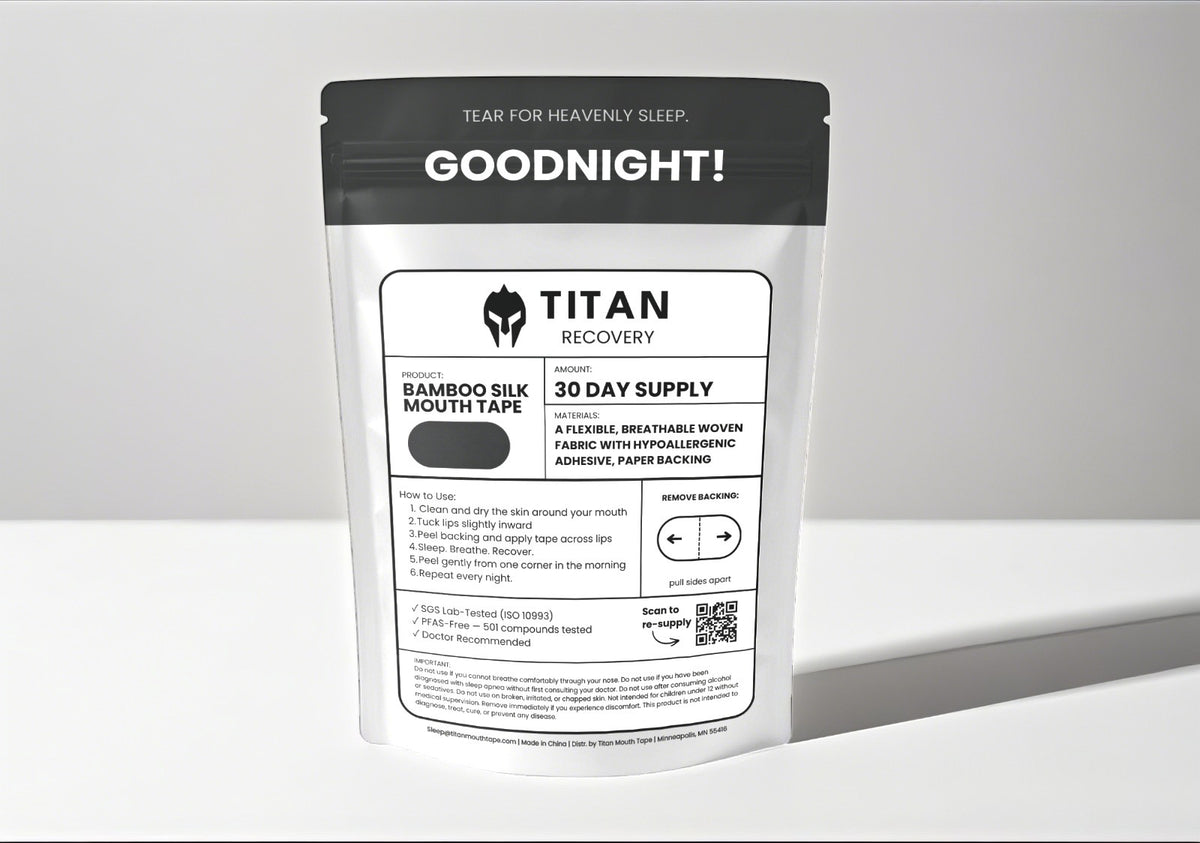
Doctor Recommended: “As a maxillofacial surgeon and dentist, I recommend Titan Mouth Tape. Nasal breathing during sleep is essential for airway health and deep restorative rest. Titan’s bamboo silk design is the most comfortable and effective mouth tape I have tested. If you struggle with snoring, dry mouth, or poor sleep quality, this is the simplest change you can make for your health.” — Dr. Francois P., MD, DDS — Maxillofacial Surgeon
Lab-Tested Safety: Titan’s SilkSeal™ adhesive is independently tested to ISO 10993 medical device standards. Non-toxic (95% cell viability). Non-allergenic (0% reaction rate). Non-irritating (score 0.0/8.0). PFAS-free — 501 compounds tested, zero detected. See full test results →
Try it tonight. Bamboo silk. SilkSeal™ adhesive. Beard-friendly. No logo on the tape. Free shipping. 30-night Better Sleep Guarantee. Shop Titan Mouth Tape → · Shop TitanAir →
This article is for informational purposes only and does not constitute medical advice. If you have or suspect a sleep disorder or other medical condition, consult a qualified healthcare provider before making changes to your routine.