Mouth Tape and Sleep Apnea: Is It Safe?
Share
If you've been diagnosed with sleep apnea — or suspect you might have it — the idea of taping your mouth shut at night raises obvious questions. Is mouth tape sleep apnea use safe? Will it make apnea worse? Could it actually help? The direct answer: mouth tape is not a treatment for sleep apnea, but it may be a useful complement to existing treatment for some people. The safety depends entirely on whether your apnea is diagnosed, how severe it is, and whether you're already on treatment.
This post is specifically about safety — who can use mouth tape alongside their sleep apnea care, who should not, and how to think about the decision responsibly. If you're looking for a broader comparison of treatment options, we've covered CPAP versus mouth tape separately.
What Sleep Apnea Actually Is (and Why It Matters Here)
Obstructive sleep apnea (OSA) occurs when the muscles in the throat relax during sleep and the soft tissue collapses inward, partially or completely blocking the airway. This blockage happens at the throat level — behind the tongue and soft palate — not at the nose or mouth. The brain detects the resulting drop in oxygen, triggers a brief arousal to restore muscle tone, and the sleeper resumes breathing, often without ever fully waking up. This cycle can repeat dozens or even hundreds of times per night.
This distinction matters because mouth tape addresses a different part of the airway. Mouth tape keeps the mouth closed to promote nasal breathing. It does not prevent the throat from collapsing. These are separate anatomical events. Treating mouth tape as a fix for obstructive sleep apnea misunderstands where the obstruction actually happens.
That said, the two issues are related. Mouth breathing and sleep apnea frequently coexist. Open-mouth breathing during sleep allows the jaw to drop, the tongue to fall backward, and the soft palate to sag — all of which narrow the throat and can worsen the airway collapse that defines OSA. So while mouth tape doesn't treat the core problem, keeping the mouth closed may reduce some of the biomechanical factors that make throat collapse more likely.
Diagnosed and Treated Sleep Apnea: Where Mouth Tape Fits
If you have diagnosed obstructive sleep apnea and you're on CPAP therapy, mouth tape may actually solve a common problem. Many CPAP users experience mouth leak — air escaping through the mouth during the night, reducing the pressure delivered to the airway and causing dry mouth, therapy disruption, and reduced treatment effectiveness. Studies have documented that mouth leak can significantly decrease the efficacy of CPAP by allowing the pressurized air to escape before it reaches the airway.
Mouth tape with CPAP. Using mouth tape alongside a nasal CPAP mask or nasal pillow mask keeps the mouth closed, which maintains the pressure seal. The pressurized air enters through the nose, the tape prevents it from leaking out the mouth, and the full therapeutic pressure reaches the airway where it's needed. Some sleep specialists actively recommend this approach for patients who struggle with mouth leak but prefer nasal masks over full-face masks.
If you use a full-face CPAP mask (one that covers both nose and mouth), mouth tape is unnecessary — the mask design already handles the mouth leak issue. But if you use nasal pillows or a nasal mask and experience dry mouth or notice your AHI numbers are higher than expected, mouth leak is a likely culprit, and mouth tape may improve your therapy compliance and results.
Oral appliance users. If you wear a mandibular advancement device (MAD) — a dental appliance that holds the lower jaw forward to keep the airway open — mouth tape can complement the device by ensuring nasal breathing. The appliance repositions the jaw; the tape keeps the mouth closed. The two work on different parts of the problem and can function well together, though you should confirm with your prescribing dentist or sleep physician that the combination is appropriate for your specific appliance.
Mild Sleep Apnea: A Gray Area
Mild obstructive sleep apnea — defined as an apnea-hypopnea index (AHI) of 5 to 15 events per hour — occupies a gray area in treatment. Many patients with mild OSA are not placed on CPAP. Treatment may involve positional therapy (sleeping on your side), weight management, or oral appliances. Some mild cases are monitored rather than actively treated.
For people with mild OSA who are not on CPAP, mouth tape is a reasonable consideration — but it's not a standalone treatment. The evidence suggests that promoting nasal breathing and keeping the mouth closed may reduce the biomechanical contributions to airway collapse. Research on nasal breathing has shown that it generates higher pharyngeal pressure than oral breathing, which may provide modest support to airway patency. Some preliminary studies have observed reduced AHI in mild OSA patients who transitioned from oral to nasal breathing during sleep.
However, "may help" is not the same as "treats." If you have mild OSA, mouth tape might improve your breathing mechanics and sleep quality, but you should still be monitored by a sleep specialist. Don't use mouth tape as a reason to skip follow-up evaluations or ignore worsening symptoms. The relationship between mouth taping and sleep apnea is a complement at best, never a substitute for medical care.
Untreated Sleep Apnea: When to Be Cautious
This is the scenario that demands the most caution. If you have moderate to severe obstructive sleep apnea and you're not currently on treatment — no CPAP, no oral appliance, no positional therapy — adding mouth tape introduces a variable into a situation that's already medically significant.
The concern is not that mouth tape will cause suffocation. As we've discussed in our safety article, sleep-grade mouth tape is breathable and your arousal reflexes remain active. The concern is more specific: with untreated moderate-to-severe OSA, your airway is already collapsing repeatedly during sleep. Closing the mouth removes one avenue for compensatory breathing. While the body can and will break through the tape if oxygen drops, adding any restriction to breathing during a night when your airway is already experiencing dozens of obstructive events is not the direction you want to go without medical guidance.
The responsible guidance is straightforward: if you suspect you have sleep apnea — snoring, daytime sleepiness, witnessed breathing pauses, waking up gasping — get a sleep study first. A home sleep test or in-lab polysomnogram will tell you whether you have OSA, how severe it is, and what treatment is appropriate. Once you have a diagnosis and a treatment plan in place, discuss mouth tape with your sleep physician as a potential add-on. Starting with mouth tape instead of a diagnosis puts the cart before the horse.
Signs You Should Get Evaluated Before Mouth Taping
- Your bed partner reports that you stop breathing during sleep or gasp awake
- You wake up with headaches most mornings
- You experience excessive daytime sleepiness despite spending enough time in bed
- You snore loudly and regularly
- You have a neck circumference greater than 17 inches (men) or 16 inches (women)
- You've been told you choke or make gurgling sounds during sleep
Any of these warrant a conversation with your doctor before adding mouth tape to your sleep routine. The goal is not to scare you away from mouth taping — it's to make sure you're addressing the bigger issue first.
Central Sleep Apnea: A Different Situation Entirely
Central sleep apnea (CSA) is a less common form of sleep apnea where the brain fails to send proper breathing signals to the respiratory muscles. Unlike obstructive sleep apnea, the airway isn't physically blocked — the body simply doesn't initiate the breath. CSA requires specialized treatment and monitoring.
Mouth tape has no therapeutic role in central sleep apnea. CSA patients should work exclusively with their sleep medicine team on appropriate treatment. If you have CSA, do not use mouth tape without explicit approval from your physician.
How to Approach Mouth Tape If You Have Sleep Apnea
The decision tree is simpler than it might seem:
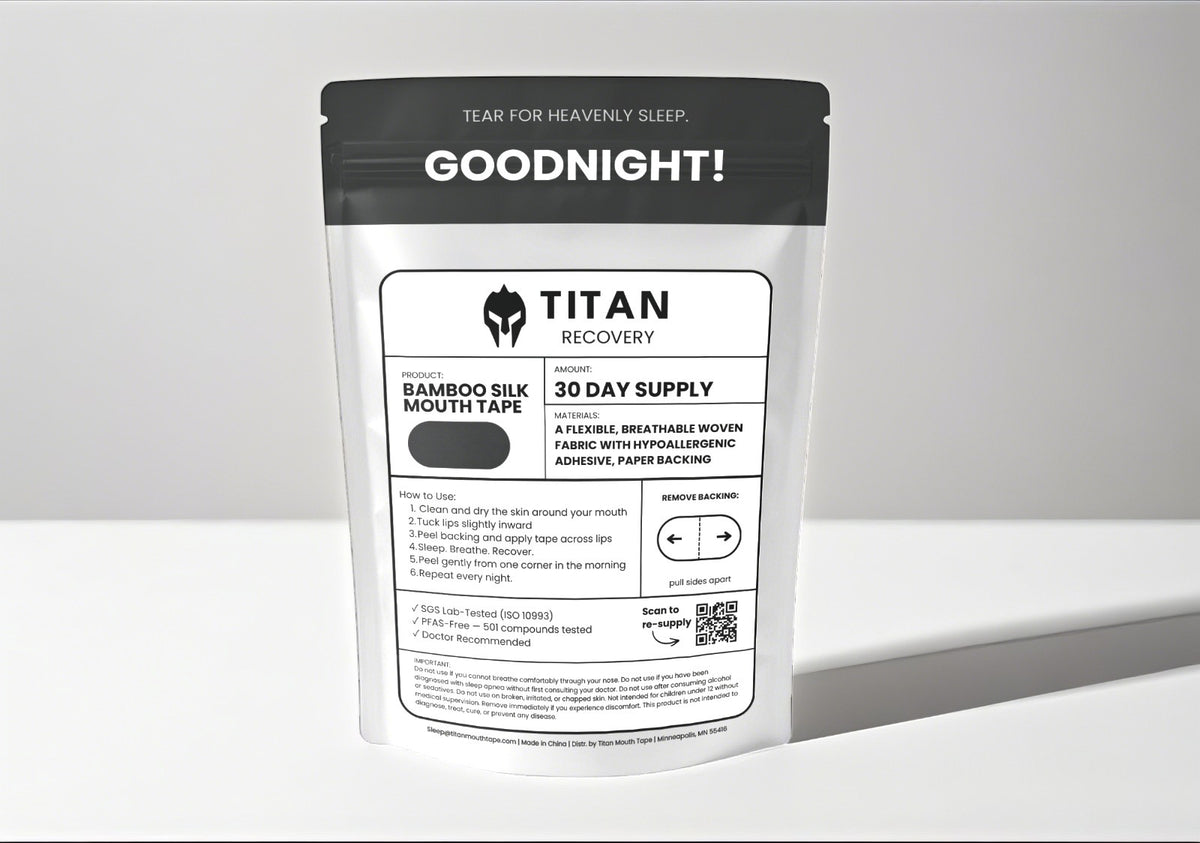
On CPAP with nasal mask and experiencing mouth leak: Mouth tape is a strong candidate. Many sleep specialists endorse this use. Start with a breathable tape like Titan Mouth Tape, use it with your nasal mask, and check your CPAP data the next morning. If leak rates drop and AHI stays the same or improves, the combination is working.
On an oral appliance: Mouth tape may complement the device. Discuss with your prescribing provider.
Mild OSA, not on CPAP: Mouth tape is worth discussing with your sleep physician. It's not a standalone treatment, but it may support better breathing mechanics overnight. Continue your monitoring schedule.
Moderate to severe OSA, untreated: Get evaluated and treated first. Nasal breathing has real benefits, but those benefits don't replace the need for appropriate sleep apnea treatment.
Central sleep apnea: Do not use mouth tape without physician approval.
The Bottom Line
Mouth tape is not a treatment for sleep apnea. It does not prevent the airway from collapsing at the throat level, which is the core mechanism of obstructive sleep apnea. But it can be a genuinely useful tool alongside proper treatment — especially for CPAP users dealing with mouth leak, where keeping the mouth closed directly improves therapy effectiveness.
The safety of mouth tape with sleep apnea depends on context. If your apnea is diagnosed and treated, mouth tape can complement your existing therapy. If your apnea is untreated and you suspect it's more than mild, the responsible step is to get a diagnosis and treatment plan before adding mouth tape to the equation. Your sleep specialist can help you figure out where mouth tape fits — or whether it does — based on your specific situation.
For those who are cleared to use it, the Titan Deep Sleep Bundle pairs our bamboo silk mouth tape with TitanAir Nasal Strips. If you're a CPAP user adding mouth tape to reduce leak, the combination of tape plus a nasal strip can further optimize airflow and comfort throughout the night.
Doctor Recommended: “As a maxillofacial surgeon and dentist, I recommend Titan Mouth Tape. Nasal breathing during sleep is essential for airway health and deep restorative rest. Titan’s bamboo silk design is the most comfortable and effective mouth tape I have tested. If you struggle with snoring, dry mouth, or poor sleep quality, this is the simplest change you can make for your health.” — Dr. Francois P., MD, DDS — Maxillofacial Surgeon
Lab-Tested Safety: Titan’s SilkSeal™ adhesive is independently tested to ISO 10993 medical device standards. Non-toxic (95% cell viability). Non-allergenic (0% reaction rate). Non-irritating (score 0.0/8.0). PFAS-free — 501 compounds tested, zero detected. See full test results →
Try it tonight. Bamboo silk. SilkSeal™ adhesive. Beard-friendly. No logo on the tape. Free shipping. 30-night Better Sleep Guarantee. Shop Titan Mouth Tape → · Shop TitanAir →
This article is for informational purposes only and does not constitute medical advice. If you have or suspect a sleep disorder or other medical condition, consult a qualified healthcare provider before making changes to your routine.