Mouth Tape for Couples: Better Sleep for Both
Share
Snoring doesn't just wreck the snorer's sleep — it wrecks their partner's sleep too. Mouth tape for couples addresses one of the most common and least-talked-about relationship problems: the fact that one person's breathing pattern is destroying the other person's rest, night after night, until someone ends up on the couch. If your partner snores — or you do — mouth taping promotes nasal breathing during sleep, which reduces or eliminates the soft-palate vibration that causes most snoring.
That's the short version. The longer version involves sleep divorce statistics, relationship resentment, the actual mechanics of how snoring affects the person lying next to the snorer, and a practical approach to getting your partner on board without turning it into a fight.
The Sleep Divorce Problem
The term "sleep divorce" describes couples who move to separate bedrooms because one or both partners can't sleep in the same room. It sounds dramatic, but it's common. Surveys from the American Academy of Sleep Medicine and similar organizations suggest that roughly 25-35% of couples sleep in separate beds or separate rooms at least some of the time. Snoring is consistently cited as the number one reason.
Sleeping apart solves the immediate problem — the non-snoring partner finally gets uninterrupted sleep. But it introduces new ones. Physical proximity matters for relationships. Bedtime is when many couples actually talk, decompress, and connect. Remove that shared space and you lose a daily touchpoint that's harder to replace than most people expect. Some couples report feeling more like roommates than partners after months of sleeping separately.
The frustrating part is that most snoring is caused by mouth breathing during sleep. When your mouth falls open, the jaw drops back, the tongue relaxes toward the throat, and the airway narrows. Air passing through that narrowed space vibrates the soft palate and surrounding tissues. That's the sound. Keep the mouth closed and the breathing routed through the nose, and in many cases, the snoring stops or drops significantly.
How One Partner's Snoring Affects the Other
Research on bed partners of snorers paints a clear picture. The non-snoring partner typically loses roughly an hour of sleep per night — not because they lie awake for a continuous hour, but because the snoring fragments their sleep cycles. They wake briefly, fall back asleep, wake again, fall back. Each arousal prevents them from completing a full sleep cycle, which means less time in deep sleep and REM sleep, which are the stages that matter most for physical recovery and cognitive function.
Over weeks and months, this chronic sleep fragmentation produces real consequences. Daytime fatigue. Difficulty concentrating. Irritability. And inevitably, resentment — because the snorer often has no idea how disruptive their breathing is. They're asleep. They don't hear it. They wake up and feel fine (or at least functional), while their partner is running on broken sleep and growing quietly furious about it.
The resentment cycle is predictable. The non-snoring partner brings it up. The snorer feels defensive — they can't control what they do in their sleep. Nothing changes. The non-snoring partner stops bringing it up and starts sleeping in the guest room. Now it's not a snoring problem anymore. It's a distance problem.
Mouth tape breaks this cycle by addressing the root cause. If the snoring is driven by mouth breathing — and the majority of non-apnea snoring is — then keeping the mouth closed during sleep targets the actual mechanism. Not a symptom. Not a workaround. The thing that's making the noise.
Getting Your Partner to Try Mouth Tape
Here's where most people go wrong: they hand their partner a strip of tape and say "you need to wear this because your snoring is ruining my life." That approach fails for obvious reasons. Nobody wants to be told their body is a problem, and nobody wants to tape their mouth shut because their partner demanded it.
Start with yourself. This is the single most effective strategy. Try mouth taping for a week or two on your own. Notice the differences — you'll likely wake up without dry mouth, feel more rested, and may notice that your own breathing is quieter. When your partner sees you doing it voluntarily and hearing you talk about the results matter-of-factly, it stops being a weird thing and starts being a thing that apparently works.
Don't nag. Mention your experience once or twice. Leave it. If they're curious, they'll ask. If they see you sleeping better, breathing quieter, and waking up without reaching for water, the evidence speaks louder than any argument.
When they're ready, make it easy. Have tape available. Suggest trying it on a weekend night when there's no alarm clock pressure. Let them know they can pull it off anytime — quality mouth tape removes easily and doesn't lock the mouth completely shut. The adjustment period is usually one to three nights. The first night feels strange. The second night feels less strange. By the third night, most people don't think about it.
Frame it as something you're doing together — not something you're imposing on the snorer. "Let's both try this" lands differently than "you need to fix your snoring."
When Both Partners Tape
Something interesting happens when both people in the bed are mouth taping: the bedroom gets genuinely quiet. No snoring from either side. No dry mouth breathing sounds. No middle-of-the-night water bottle reaching. Both partners stay in nasal breathing all night, which means both get better-quality sleep — deeper sleep cycles, better oxygen saturation, and more time in the restorative stages.
Couples who both tape consistently report a few specific changes. They stop waking each other up. They stop the unconscious nudging and "roll over" requests that fragment both people's sleep. Morning breath improves for both partners because the mouth isn't drying out overnight — saliva maintains its antibacterial function when the mouth stays closed. And the resentment fades because the problem that created it is gone.
There's also a practical element: when only one partner tapes, the other sometimes views it as the taper's "thing" — a quirky habit. When both do it, it becomes part of the shared bedtime routine, like setting the thermostat or turning off the lights. It normalizes quickly.
The Beard Factor
In many couples, the snoring partner is male, and many men have facial hair. This is one of the most common objections: "tape won't stick to my beard" or "it'll rip my hair out in the morning." Both concerns are valid with the wrong tape and wrong technique, but neither is a real barrier.
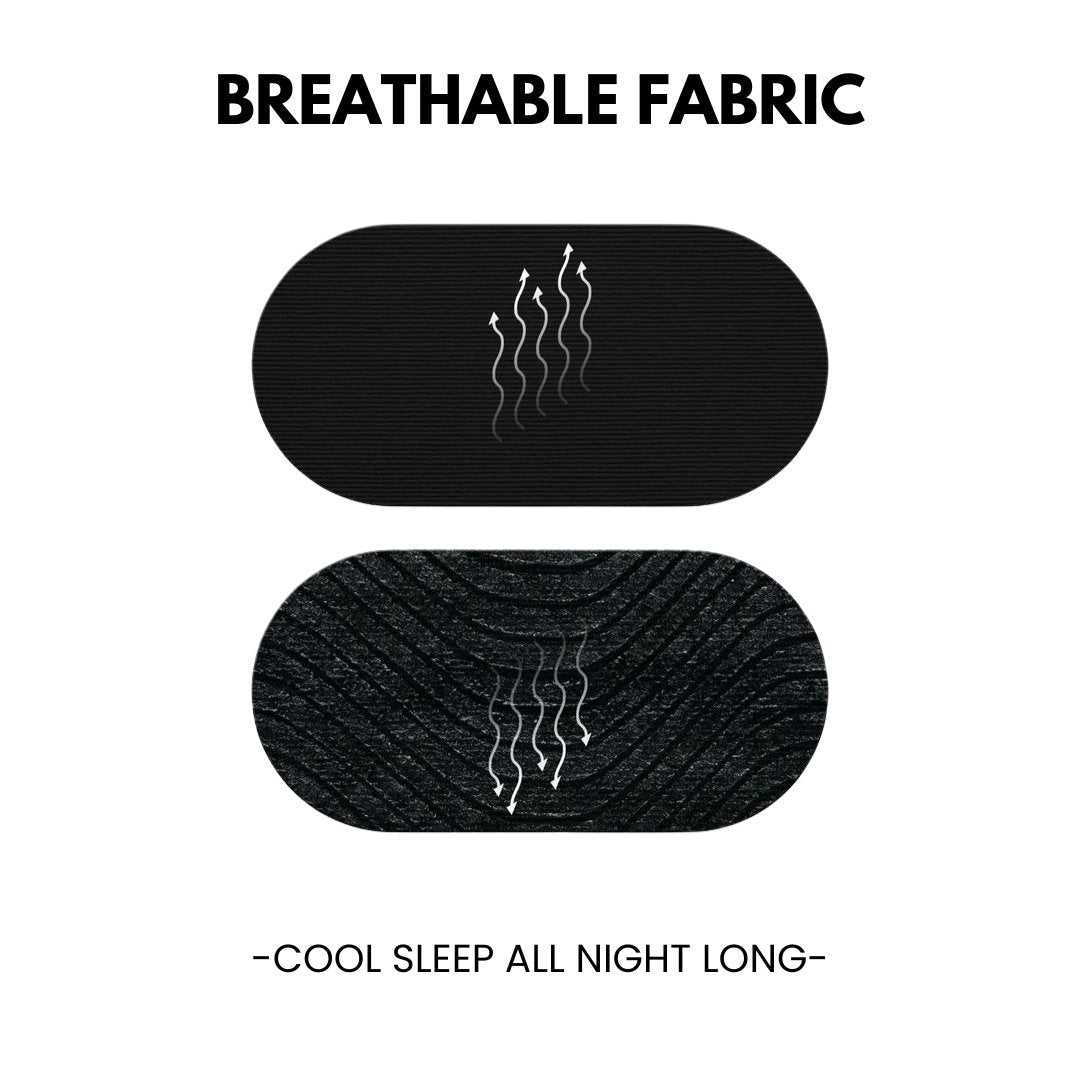
The key is vertical placement — applying the tape from just below the nose, straight down over the center of the lips. The adhesive contacts the lip surface and the smooth skin of the philtrum, avoiding the bearded areas on the cheeks and jaw entirely. With a bamboo silk tape that uses medical-grade adhesive, the bond is strong enough to hold all night but gentle enough to release without pulling facial hair. We wrote a full guide to mouth taping with beards that covers placement, beard oil timing, and mustache-specific techniques.
When Mouth Tape Isn't the Answer
Honesty matters here. Mouth tape addresses snoring caused by mouth breathing — which accounts for a large share of snoring in otherwise healthy adults. But it doesn't treat obstructive sleep apnea, and it shouldn't be used as a substitute for medical evaluation when the signs point in that direction.
If your partner's snoring includes gasping, choking, or long pauses in breathing followed by a sudden snort or gasp, that pattern suggests sleep apnea, not simple mouth-breathing snoring. Sleep apnea involves a physical obstruction of the airway that mouth tape cannot and should not attempt to address. Your partner needs a sleep study and proper diagnosis before trying any at-home intervention.
Similarly, if one partner has chronic nasal obstruction — from a deviated septum, severe allergies, or nasal polyps — mouth taping may not be comfortable or effective until the nasal breathing pathway is clear. Nasal strips can help with mild congestion, but structural issues need medical attention.
Mouth tape is a tool, not a cure-all. For the right problem — mouth-breathing snoring that's keeping your partner awake and pushing you toward separate bedrooms — it's a simple, effective tool that addresses the actual cause.
Frequently Asked Questions
Will mouth tape actually stop my partner's snoring?
If the snoring is caused by mouth breathing — which is the case for the majority of non-apnea snorers — then yes, mouth tape can significantly reduce or eliminate snoring by keeping the airway open through the nose. Snoring caused by other factors like sleep apnea, nasal obstruction, or alcohol-related muscle relaxation may not respond to mouth tape alone.
Is it safe to sleep next to someone wearing mouth tape?
Yes. Quality mouth tape uses a gentle adhesive that can be removed instantly by the wearer — it doesn't seal the mouth shut in a way that prevents breathing. If the nasal airway becomes blocked during sleep, the tape is easy to dislodge with normal mouth movement. It's not duct tape. It's a medical-grade adhesive strip designed for sleep.
What if my partner refuses to try mouth tape?
Start by using it yourself. Leading by example is more persuasive than any conversation. Let your partner observe the results — quieter sleep, no dry mouth, better rest — without pressure. Many people come around after seeing it work firsthand on someone they trust. If they still aren't interested, respect that, but keep using it yourself for your own sleep quality.
Can we both use the same type of mouth tape?
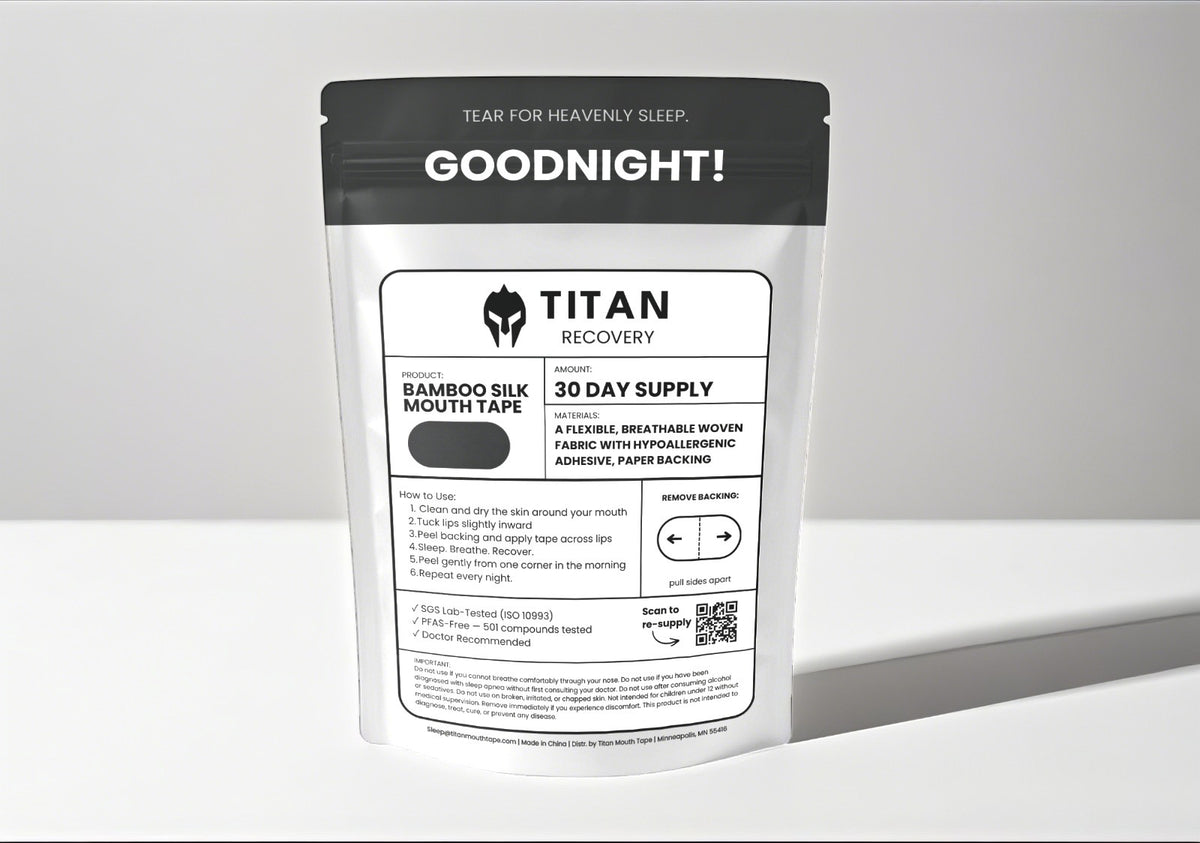
Absolutely. Titan Mouth Tape works for all face shapes and sizes. The vertical application method adapts to different lip and face proportions. For the partner with facial hair, the same tape applies with the vertical placement method — no special "beard version" needed.
How long before we notice a difference in sleep quality?
The snoring reduction is typically immediate — the first night of consistent nasal breathing usually produces noticeably quieter sleep. The broader sleep quality improvements — feeling more rested, less daytime fatigue, better morning hydration — tend to become clear within the first week. The non-snoring partner often notices the difference before the snorer does, simply because the silence is so obvious.
The Bottom Line
Snoring is a solvable problem for most couples. Not with earplugs, white noise machines, or separate bedrooms — those are workarounds that manage the symptom while the cause persists every night. Mouth tape addresses the mouth breathing that drives most snoring, and it does so without surgery, devices, or prescriptions.
If snoring is creating distance in your relationship — whether that's literal distance between bedrooms or the emotional distance that builds from chronic sleep disruption and unspoken resentment — try the simple thing first. One person starts taping. The results speak for themselves. The other person gets curious. Before long, you're both sleeping quietly in the same bed, waking up rested, and wondering why you didn't try this sooner.
The Titan Deep Sleep Bundle includes mouth tape and nasal strips — enough for both partners to try it for several weeks and see real results.
Doctor Recommended: "As a maxillofacial surgeon and dentist, I recommend Titan Mouth Tape. Nasal breathing during sleep is essential for airway health and deep restorative rest. Titan's bamboo silk design is the most comfortable and effective mouth tape I have tested. If you struggle with snoring, dry mouth, or poor sleep quality, this is the simplest change you can make for your health." — Dr. Francois P., MD, DDS — Maxillofacial Surgeon
Lab-Tested Safety: Titan's adhesive is independently tested to ISO 10993 medical device standards. Non-toxic (95% cell viability). Non-allergenic (0% reaction rate). Non-irritating (score 0.0/8.0). PFAS-free — 501 compounds tested, zero detected. See full test results →
Try the complete system tonight. Titan Mouth Tape (bamboo silk, SilkSeal™ adhesive) + TitanAir Nasal Strips. Free shipping. 30-night Better Sleep Guarantee. Shop Titan Mouth Tape → · Shop TitanAir Nasal Strips →
This article is for informational purposes only and does not constitute medical advice. If you have or suspect a sleep disorder or other medical condition, consult a qualified healthcare provider before making changes to your routine.