Why You’re Still Tired After 8 Hours of Sleep
Share
You went to bed at 10. You woke up at 6. Eight full hours. And you feel like you slept for three.
So you do what everyone does. You Google it. You blame your mattress. You try melatonin. You cut caffeine after 2pm. You buy a sleep tracker and stare at charts that tell you what you already know: something is wrong.
But here's the thing nobody tells you — the problem might not be how long you sleep. It might be how you breathe while you're sleeping.
The Hidden Cost of Mouth Breathing at Night
When you sleep with your mouth open, your body may never fully enter recovery mode.
Research suggests mouth breathing activates your sympathetic nervous system — the fight-or-flight branch. Your heart rate stays elevated. Your cortisol stays elevated. Your body spends the night in a low-grade state of arousal, even though your eyes are closed and you're technically unconscious.
The deep sleep stages — Stage 3 and REM — are where the real recovery happens. This is when growth hormone is released. When muscle tissue repairs. When memories consolidate. When your immune system recharges. These stages require your parasympathetic nervous system to be dominant. That's the rest-and-recover branch. The one that slows your heart, drops your blood pressure, and tells every system in your body: stand down, we're rebuilding tonight.
Research published in Neuroreport found that nasal breathing is associated with parasympathetic activation. Mouth breathing is associated with sympathetic activation.
So you can be in bed for eight hours, asleep for seven of them, and still wake up exhausted — because your body may never have shifted into the gear where recovery actually happens.
Why Your Sleep Tracker Can't Tell You This
Most consumer sleep trackers measure movement, heart rate, and sometimes blood oxygen. They estimate your sleep stages based on these signals and give you a "sleep score."
What they don't measure is how you're breathing.
A tracker might show that you spent 45 minutes in deep sleep. What it can't show is that your mouth was open for six of your seven hours asleep, your tongue was partially blocking your airway, your blood oxygen was dipping every time you rolled onto your back, and your nervous system was running in stress mode the entire night.
The tracker sees hours. Your body experiences quality. And the gap between those two things is often explained by one variable: whether your mouth was open or closed.
The Oxygen Problem You Don't Know About
Your nasal passages do something your mouth cannot: they produce nitric oxide.
Nitric oxide is a signaling molecule that dilates blood vessels in the lungs, which may improve oxygen transfer from the air you breathe into your bloodstream. Research published in the American Journal of Respiratory and Critical Care Medicine found that nasal breathing increased arterial oxygenation compared to mouth breathing.
But there's a second mechanism that's less well-known and arguably more important.
When you breathe through your mouth, you may exhale CO2 too quickly. This drops the CO2 concentration in your blood. And counterintuitively, lower CO2 may make it harder for your hemoglobin to release oxygen to your tissues. This is called the Bohr effect — the biological principle that CO2 is required for efficient oxygen delivery at the cellular level.
So mouth breathers may be in a paradox: breathing more air, but their cells receiving less oxygen. More volume, less efficiency. All night long.
The result may be a body that spent eight hours in bed but was mildly oxygen-deprived the entire time. And when your cells don't get adequate oxygen, recovery may slow across every system — muscles, brain, immune function, all of it.
That's why you wake up tired.
The Dry Mouth Connection
Here's a simple diagnostic question: do you wake up with a dry mouth?
If yes, your mouth was open all night.
Dry mouth isn't just uncomfortable. It means your saliva flow was disrupted for hours. Saliva protects your teeth by neutralizing acids, washing away bacteria, and delivering minerals to your enamel. Without it, your oral environment becomes acidic and hostile. This is why chronic mouth breathers may develop cavities, gum inflammation, and persistent bad breath — even when their brushing habits are excellent.
But the dry mouth itself is also a sign of something deeper: your breathing pattern was wrong all night. The dryness is the symptom. The mouth breathing is the cause. And the fatigue you feel is the downstream consequence.
If you wake up with a dry mouth and feel tired despite sleeping enough hours, those two things are likely connected — and they may share a single root cause.
What About Stress? Screens? Caffeine?
These all matter. Nobody is saying they don't.
Stress raises cortisol, which may interfere with sleep onset and deep sleep. Screen exposure before bed suppresses melatonin production. Caffeine has a half-life of 5-7 hours, meaning a 3pm coffee is still roughly 50% active in your system at 9pm.
But here's what's worth considering: you may have already addressed these things. You may have cut caffeine, put the phone away, dimmed the lights, done everything the sleep hygiene articles tell you to do — and you're still waking up tired.
That's because sleep hygiene advice addresses inputs — what you do before sleep. It doesn't address what happens during the eight hours you're unconscious. And during those eight hours, the single biggest variable you can influence is whether your mouth is open or closed.
If you've optimized everything before bed and still feel unrested, your breathing during sleep is the most likely unaddressed factor.
The Snoring Connection
You might not think you snore. But if you sleep alone, you don't actually know.
Snoring is caused by air vibrating through a partially obstructed airway. When the mouth falls open during sleep, the tongue drops backward, the airway narrows, and the conditions for snoring are created — even in people who have never been told they snore.
Light snoring can fragment your sleep without waking you up fully. You won't remember it in the morning. Your sleep tracker might not flag it. But your brain registered the micro-arousals, and your sleep architecture was disrupted.
This is one of the most common hidden causes of unrefreshing sleep. You slept enough hours. You didn't wake up (that you recall). But your airway was partially obstructed for much of the night, your sleep stages were fragmented, and your body never got the deep, uninterrupted recovery it needed.
The Signs You're a Nighttime Mouth Breather
Most people don't know they breathe through their mouth at night. Here's how to tell:
You wake up with a dry mouth, sticky tongue, or sore throat. Your breath is noticeably bad in the morning even though you brush before bed. Your lips are dry or chapped when you wake up. You feel tired after a full night of sleep — consistently, not just occasionally. You wake up with a headache. You get frequent cavities despite good dental hygiene. Your partner says you snore (even lightly). You sometimes wake up briefly at night for no apparent reason.
If three or more of these apply, mouth breathing during sleep is very likely contributing to your daytime fatigue.
The Simplest Fix You Haven't Tried
Before you buy another supplement, download another meditation app, or replace your mattress — try taping your mouth.
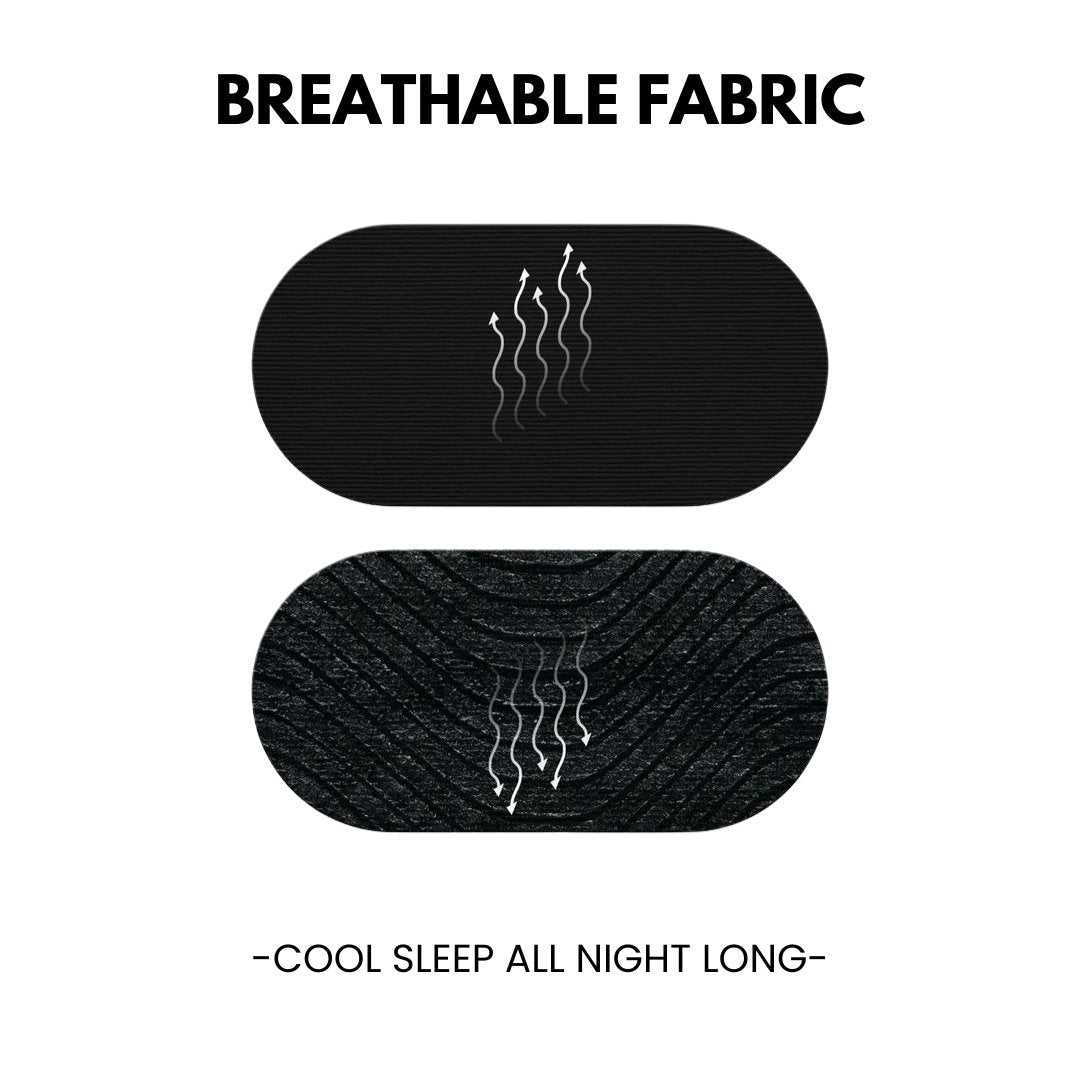
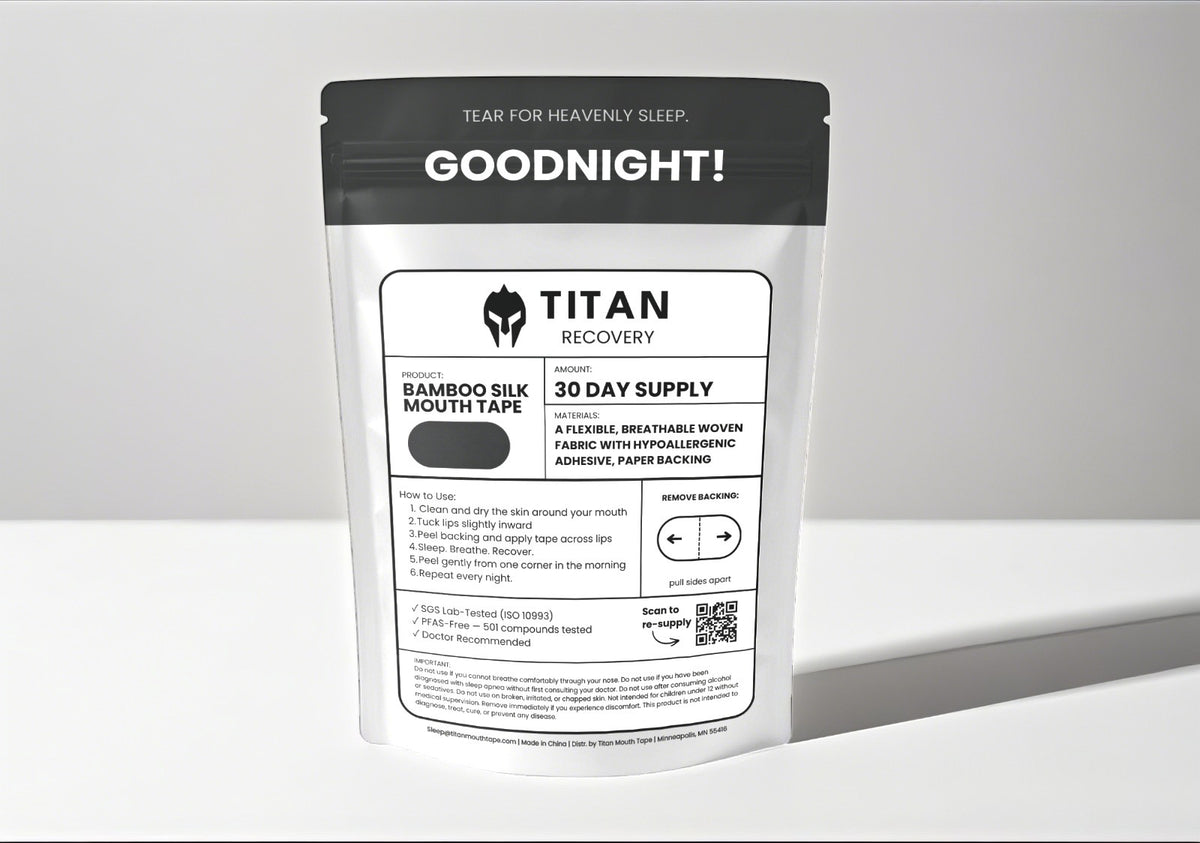
One strip of tape across your lips before bed. It holds your mouth gently closed. Your tongue stays against the palate. Your airway stays open. Your nose does the breathing. Nitric oxide gets produced. Your parasympathetic nervous system may engage. Your deep sleep stages aren't interrupted by airway vibration.
It takes five seconds to apply. You remove it in the morning. There's nothing to charge, no subscription, no side effects with a tested adhesive.
The first morning after is often the most telling. People describe it as the first time they've woken up actually feeling rested — not just having slept. There's a difference, and most people don't realize it until they experience it.
If nasal congestion makes nose breathing difficult, pair mouth tape with a nasal strip — one opens the nose, one closes the mouth. Together they create a complete nasal breathing system.
Eight hours in bed means nothing if your body can't recover during those hours. Address the breathing, and the hours may start counting.
Doctor Recommended: "As a maxillofacial surgeon and dentist, I recommend Titan Mouth Tape. Nasal breathing during sleep is essential for airway health and deep restorative rest. Titan's bamboo silk design is the most comfortable and effective mouth tape I have tested. If you struggle with snoring, dry mouth, or poor sleep quality, this is the simplest change you can make for your health." — Dr. Francois P., MD, DDS — Maxillofacial Surgeon
Lab-Tested Safety: Titan's adhesive is independently tested to ISO 10993 medical device standards. Non-toxic (95% cell viability). Non-allergenic (0% reaction rate). Non-irritating (score 0.0/8.0). PFAS-free — 501 compounds tested, zero detected. See full test results →
Try it tonight. Bamboo silk. SilkSeal™ adhesive. Beard-friendly. No logo on the tape. Free shipping. 30-night Better Sleep Guarantee. Shop Titan Mouth Tape → · Shop TitanAir →